Overview
Vibes'n'Feels is a consumer mobile application that binds a fresh photograph or a short video to a physical place, an emotional reading, and a deliberately chosen audience. Built by Pavel Bochkov Rastopchin and attributed to the VisioFutura studio, the product describes itself as an emotion map of moments and places. Rather than assembling another social feed organized around profiles and follower counts, the app arranges shared content around geography, time, and feeling. Each entry, called a Vibe, combines a live camera capture, a nearby map pin, an emoji chosen from one of six emotional spectra, and an optional written note.
The company frames the product as an alternative to performance-oriented social platforms. Its public messaging rejects follower counts, public profile histories, popularity rankings, and direct messages. The service is in private testing, with Google Play and App Store listings marked as coming soon. The interface and support materials are offered in English and Russian, and access is limited to adults aged 18 or older. The landing page does not publish a headquarters address, though the site credits the VisioFutura project. The operation reads as a small, design-led team rather than an enterprise-scale platform, and its distribution strategy depends on app store release rather than web access.
Services & Expertise
Location-anchored live capture. Every Vibe starts with a fresh camera action rather than a gallery import. Location access is mandatory so the capture can be connected to a nearby place, and the pin can then be repositioned within roughly 250 meters of the position detected by the device. Photographs already stored on a phone cannot become Vibes, a restriction that enforces immediacy and keeps the archive tied to genuine presence.
Six-spectrum emotional tagging. After capture, the user selects one of six emotional spectra: Joy, Love, Anger, Sadness, Discomfort, and Surprise. Each spectrum opens a refinement row of expressive emoji so the signal can be narrowed beyond a single generic reaction. The company states plainly that this is contextual labeling and not mood tracking, diagnosis, or mental-health advice.
Audience-scoped sharing tiers. A Vibe can be kept Personal, shared with Friends for three days, or shared with Everyone for 24 hours at a specific pin. Personal Vibes remain on the device. Friends-only sharing sits outside the public sharing limit. Public sharing triggers a safety review of the photograph or video before it appears on the community map.
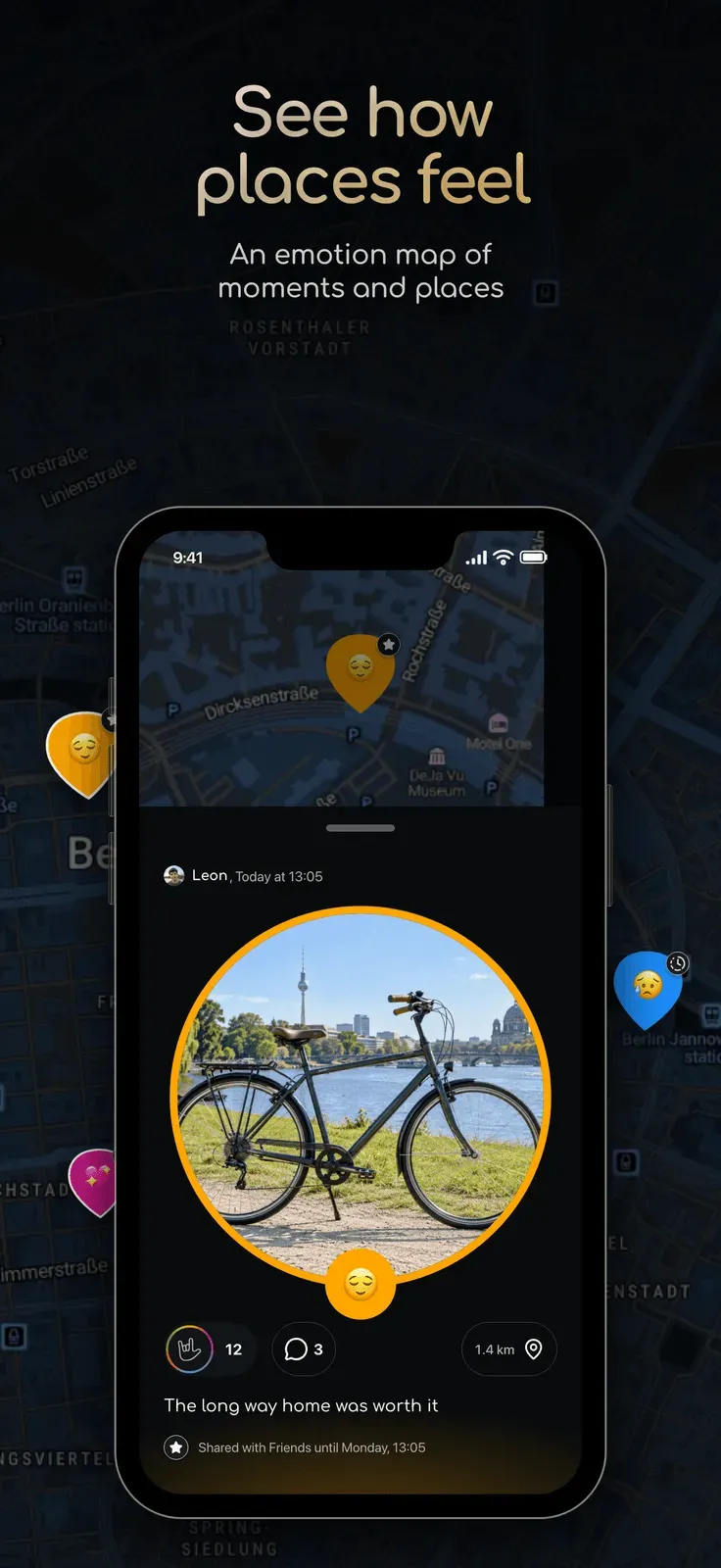
Interactive emotion map and feed. Visible Vibes surface on a geographic map and in a scrolling feed. Map pins carry color coding matched to an emotional spectrum, and the feed shows contributor first name, timestamp, distance, note text, and expiry timing. The layout is organized around place and moment rather than personalities, which distinguishes it from conventional photo-sharing networks.
Discuss conversations bound to a live Vibe. Discuss is a threaded conversation attached to one live Shared Vibe, and it closes automatically when that Vibe expires. Threads support replies, mentions, and lightweight reactions, keeping commentary attached to a specific moment instead of accumulating indefinitely on a persistent profile.
Feels reactions without public attribution. A Feel is a small response to a single live Shared Vibe. Counts stay visible, but supporter identities are not shown publicly, and the app states that Feels never change discovery or ranking. This removes the competitive incentive that reaction systems usually create.
Privacy architecture and sync limits. Camera originals are never uploaded. Sharing and syncing use a processed JPEG for photos or an MP4 with a JPEG poster for video, and shared video may be reviewed through sampled frames and speech. A confirmed account can sync up to 1 GB of its newest eligible Vibes. A Shared Vibe also exposes the exact map pin selected, but only to the audience chosen for that Vibe while it remains live.
How They Work
The user journey is linear and brief. After installing the app and granting location permission, a user opens the Add flow and chooses Photo or Video. Video recordings are capped at 20 seconds and require a confirmed account even when the Vibe stays Personal. The app then asks for a place, presenting a draggable pin inside a bounded circle so the location can be refined. The camera opens next for a fresh capture and a crop adjustment, after which the user picks a spectrum, refines the emoji, and selects an audience tier before saving.
Account requirements scale with ambition. An email address is optional at the outset, and a user can begin with Personal Vibes alone. Confirming an account unlocks Friends, writing in Discuss, a custom avatar, every Video Vibe, and sync plus restore for up to 1 GB of the newest eligible Vibes. Friend connections are private and mutual, established by exact username only, with no people search and no public friend list. Moderation sits between saving and publishing: when a Vibe is shared with Everyone, photographs and videos are checked for safety before appearing on the public map, and sampled frames and speech may be analyzed for shared video.
When the sharing window closes, the Vibe stops being available to that audience, although the Personal version can persist locally. Limited safety records may be retained as described in the published Privacy Policy. Discovery relies on Map and Feed views rather than algorithmic ranking, which keeps visibility tied to recency and geography instead of engagement metrics. Legal terms and data handling details are documented in the Terms of Use and the account deletion page.
Ideal Client Profile
Urban explorers and short-trip travelers. A traveler spending two days in an unfamiliar city benefits from the map-first structure, because each Vibe records a real corner, cafe, or park alongside the feeling it produced. The 24-hour public window keeps the map current and prevents stale tourist content from accumulating.
Close-knit friend groups separated by distance. Friends who want a private, low-pressure channel rather than a broadcast network fit the Friends tier well. The three-day window, mutual connection model, and absence of follower counts create a small, contained audience without the pressure of public metrics.
Privacy-conscious adults leaving mainstream platforms. Anyone unsettled by persistent profiles, engagement ranking, and open direct messages gains from the ephemeral design. Personal Vibes remain on the device, originals are never uploaded, pin visibility is scoped to the chosen audience, and the service is restricted to adults aged 18 and older.
Place-focused photography hobbyists. A photographer who cares less about portraits and more about capturing the atmosphere of a specific location will find the fresh-capture requirement aligned with the intent. The ban on gallery imports guarantees that every published image was taken in the place it claims.
Small creative and neighborhood communities. Groups documenting a district, a festival, or a recurring local event can use public Vibes as a time-boxed emotion map. Because reactions do not affect ranking, quieter contributions remain visible for their full 24-hour window.
Pricing & Engagement Models
The landing page does not publish subscription tiers, in-app purchase pricing, or advertising plans. The product is presented as a free consumer application currently in private testing, with both app store buttons disabled and accompanied by the notice that it is coming soon to stores. No enterprise licensing, agency partnership program, or tiered membership is described anywhere on the site.
Engagement is therefore structured around usage limits rather than payment levels. Personal Vibes carry no cost implication. Friends sharing runs for three days and sits outside the public sharing limit. Public sharing is capped at 24 hours per Vibe. Sync and restore applies to the newest 1 GB of eligible Vibes and requires a confirmed account. Anyone evaluating the service commercially should treat the current terms as provisional until the store release publishes final pricing, and should note that no free trial, refund policy, or paid consultation is advertised at this stage.
Editorial Assessment
Vibes'n'Feels takes a coherent position and defends it consistently. Binding content to place and time, refusing gallery imports, capping public visibility at 24 hours, and withholding supporter identities all reinforce the same idea: capture what is happening now, share it briefly, and keep what matters privately. The absence of follower counts and ranking mechanics is not a missing feature but a deliberate constraint, and the documentation is unusually transparent about what is uploaded, what is checked, and what expires.
The trade-offs are real. Mandatory location access and the prohibition on gallery uploads will frustrate users who want to post on their own schedule or from indoors. The absence of direct messages and persistent profiles limits social depth. Public reach is short, and another person can still screenshot a Vibe while it is visible. The 18-and-over restriction and the confirmed-account requirement for all video narrow the addressable audience, and the private testing status means pricing, moderation capacity, and long-term roadmap remain unverified.
The strongest fit is an adult user who wants a lightweight, place-based record of felt experience and values expiration over accumulation, particularly city explorers, small friend circles, and privacy-first defectors from mainstream networks. Anyone seeking audience growth, brand marketing reach, or long-term content archives should look elsewhere. As an early-stage product, it is well specified and internally consistent, but its claims deserve reassessment once public release terms and moderation practices are visible.