
Overview
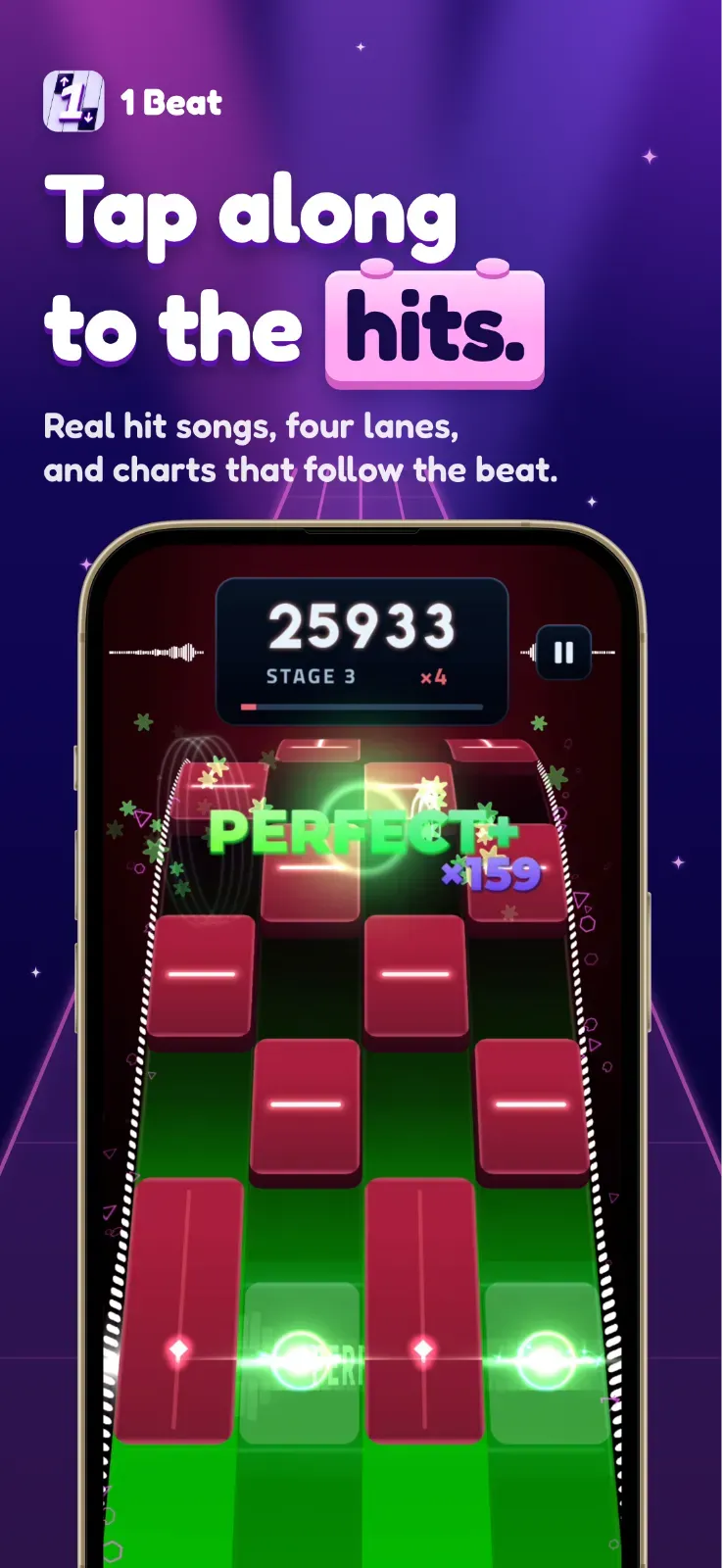
1 Beat: Hit Music Game is a forthcoming free-to-play rhythm game for iPhone and Android from a developer that positions the title as a direct answer to lessons learned from Beatstar. The public site presents the game as in development, with no download available and a waitlist for an early build. Its central proposition is simple: chart-topping songs, a portrait playfield, and four lanes rather than the three lanes associated with Beatstar. The game is built around taps, holds, and swipes, with notes falling toward a judgement line and thumb pads placed below that line. The catalogue described on the site spans pop, rock, hip-hop, and EDM. The landing page does not disclose a founding year, headquarters, team size, or release date. It does disclose that Beatstar's servers shut down on 31 October 2025, and it frames 1 Beat as a project informed by that game's strengths and limitations. The studio's public materials include a blog, a press page, an audio offset calculator, and a set of guides for players affected by Beatstar's closure. The developer explains the design rationale in How a four-lane rhythm game plays. In market terms, 1 Beat sits in the mobile rhythm game segment, where licensed or recognizable music, responsive timing, and fair touch controls matter more than broad feature lists. Its current status is pre-launch, so the site functions as product explanation, design manifesto, and waitlist acquisition page rather than a storefront.
Services & Expertise
Four-lane rhythm gameplay. 1 Beat uses a portrait playfield with four lanes. The site argues that adding one lane changes pattern possibilities: three lanes give six ways to hit one or two notes at once, while four lanes give ten. The intended outcome is a chart system that remains readable but offers more room for cross, split, and stacked patterns. This is the product's main differentiator from Beatstar's three-lane design.
Tap, hold, and swipe note types. The game keeps the three note interactions familiar to Beatstar players. Taps, holds, and swipes form the core vocabulary, and the stated aim is to make charts harder to master rather than harder to read. That choice lowers the learning burden for experienced mobile rhythm players while preserving room for expert-level sequencing. The site does not announce final song titles or difficulty tiers.
Portrait, two-thumb control design. One hand can operate the game, but the site notes that two hands work better. Each thumb gets two lanes, enabling patterns that cross, split, and stack. This matters on phones because portrait orientation supports commuter play and one-handed reach, while the two-thumb layout supports higher-level charting. The game does not require a controller or a tablet-sized screen according to the public description.
Touch-event timing and judgement. Timing is read from the touch event rather than delayed until the next frame. The practical goal is to prevent a dropped frame from becoming a missed note. For rhythm games, judgement fairness is a core quality signal, and this design choice addresses a common mobile performance issue. The site presents it as one of the six features in the game's core feature list.
Per-device audio offset calibration. 1 Beat stores an audio offset for each pair of headphones or output device. Players calibrate once per device instead of once per session. The site also acknowledges that a stored offset does not remove Bluetooth drift. Before launch, players can use the audio offset calculator to measure device latency. This feature targets wireless earbud users, a large segment of mobile rhythm players.
Accessibility and comfort controls. The game includes a reduced-flashing mode that gates every visual effect with a single switch. The site also makes no-fail the default, so a weak run ends as a score rather than a prompt to watch an advert to continue. These choices suggest attention to photosensitivity, interrupted play, and low-pressure practice. They are not framed as optional extras buried in a menu, but as default design decisions.
Competitive and social scoring. Screenshot captions reference beating friends' scores and a weekly leaderboard. The public copy does not detail ranking mechanics, seasons, or social features, but the screenshots indicate that score comparison is part of the intended experience. For rhythm players, leaderboards extend replay value beyond song completion. The site does not confirm cross-platform competition or account systems.
How They Work
The current engagement path is a pre-launch waitlist rather than a downloadable app. A visitor can read the game explanation, review screenshots, compare the four-lane board with Beatstar's three-lane board, and join the waitlist with an email address. The site states that the list will be used to email once there is a build to try and for nothing else. No app is available for iPhone or Android at the time described. There is no public release date, beta schedule, or store listing beyond coming soon labels for the App Store and Google Play. The site also provides a blog, a press kit, and reference pages for players arriving from Beatstar. Those pages include comparisons, account recovery guidance, and a guide to alternative games. For players displaced by Beatstar's shutdown, the site maintains a guide to games like Beatstar. Once a build exists, the described play loop is straightforward. Notes fall toward a white judgement line, and thumbs rest on pads beneath it. The tap area sits below the line so thumbs do not cover incoming notes. Judgement reads the touch event directly. Players can calibrate audio offset per device and enable reduced flashing. No-fail is the default. The development approach is iterative in presentation: screenshots, diagrams, and a feature list explain intent before release. The site does not publish a public roadmap, changelog, or technical stack.
Ideal Client Profile
Former Beatstar players seeking a four-lane alternative. Players who spent time with Beatstar and want a similar portrait rhythm game with tap, hold, and swipe notes are the clearest audience. The site directly compares the lane count and keeps the same three note types. The free-to-play model and waitlist lower the commitment. This group should recognize the control vocabulary immediately, though the final song list remains unknown.
Mobile rhythm players who prefer portrait play. Players who play on a phone during commutes or short sessions fit the portrait, one-hand or two-thumb design. The tap pads below the judgement line are intended to keep the playfield visible. The feature set favors quick sessions and device-specific calibration. This is not positioned as a tablet-first or controller-based rhythm game.
Players using wireless earbuds or multiple headphones. The per-device offset feature targets listeners who move between Bluetooth earbuds, wired headphones, and phone speakers. The site is candid that Bluetooth drift remains a limitation, but it treats calibration as a first-class setting. Players who have blamed themselves for timing problems on wireless audio are a natural fit. The audio offset calculator offers a pre-launch way to measure device behavior.
Accessibility-conscious players and low-pressure learners. The reduced-flashing mode and no-fail default make the game relevant to players who avoid intense visual effects or failure prompts. The no-fail choice supports practice and score chasing without forced ad continuations. The site does not claim full accessibility certification, but these settings are concrete. Players who want a rhythm game that respects photosensitivity and interrupted play should monitor the project.
Score chasers and socially competitive players. Screenshot captions mention friends' scores and a weekly leaderboard. Players who enjoy comparing runs and returning for weekly competition are a plausible audience. The public site does not yet detail anti-cheat, ranking tiers, or account systems. Competitive players should wait for more information before treating leaderboards as a confirmed core feature.
Pricing & Engagement Models
1 Beat is described as free to play. The site does not publish pricing tiers, in-app purchase details, ad policies, or subscription options. There is no paid early access offer, no preorder, and no download link. The only current engagement model is a free waitlist that promises an email when a build is available. The site says the list will not be used for other messages. For a pre-launch mobile game, that means commercial terms beyond the free-to-play label are not yet public. Players cannot evaluate value against a paid package because no package exists. The absence of pricing detail is not unusual for a game still in development, but it leaves monetization, ad frequency, and song access unresolved. The audio offset calculator and blog are free resources. No consultation, trial, or guarantee applies because this is a consumer game rather than a professional service.
Editorial Assessment
1 Beat: Hit Music Game presents a focused, technically literate pitch. Its strongest ideas are the four-lane portrait layout, the tap area below the judgement line, touch-event timing, per-device offset, no-fail default, and a full reduced-flashing switch. These choices address real mobile rhythm game problems rather than adding unrelated features. The site is also unusually candid about what remains unfinished: the song list, the charts, Bluetooth drift, and the release date are all acknowledged as open. The main limitation is availability. There is no app to test, no confirmed catalogue, and no public build, so the quality of chart design and music licensing cannot be verified. The reliance on Beatstar comparisons is understandable given the shutdown, but it also means the product must eventually stand on its own song library and chart identity. The best fit is a patient rhythm player, especially a former Beatstar user, who values four-lane design and timing calibration and is comfortable joining a waitlist. Players who need a released game with a known catalogue should explore available alternatives while monitoring this project. Overall, 1 Beat is worth watching for mobile rhythm fans who want a more pattern-rich, portrait-friendly take on the tap, hold, and swipe formula.