Overview
SysRound is a browser-based interview preparation platform built for software engineers working through technical hiring loops at large technology employers. Its offering rests on three pillars: a searchable library of reported interview questions indexed by company, structured coding study plans with an integrated practice workspace, and a spoken AI mock interview dedicated to the system design round. The site reports 8,847 interview questions attributed to 489 companies, alongside 205 coding problems with checked examples and 267 system design prompts that each carry a private interviewer brief covering scope, scale numbers, deep dives and the bar for a given level.
The product occupies a middle position between two established formats. Free question aggregators deliver breadth without simulation, while human coaching marketplaces deliver simulation at a high hourly rate. SysRound attempts to split the difference by keeping study material free and charging only for AI-led mock rounds, purchased as credit packs rather than a recurring subscription. The company operates in open beta, authenticates users with emailed sign-in codes instead of passwords, and publishes a footer notice stating that the AI interviewer and AI feedback can be wrong and that the tool is intended for personal practice rather than hiring decisions. Feedback is calibrated to mid-level (L4/E4), senior (L5/E5) and staff (L6+/E6+) bands, with the selected level changing the depth of questioning and how much the interviewer leads.
Services & Expertise
Company question library. The core free asset is a database of reported questions mapped to individual employers, with pages for Meta, Amazon, Google, OpenAI, Microsoft, Anthropic, Uber, LinkedIn, Apple, Bloomberg, Oracle, Airbnb and roughly 476 further companies. Each question entry displays its sources and the dates of the underlying reports, which lets candidates judge how current a prompt is. The site is explicit that a company tag is an attribution, not a guarantee that the same question will appear in a live loop.
Coding study plans. Two sequenced curricula organize practice by pattern rather than by topic. Coding Patterns 150 spans 150 problems across 18 groups and is positioned for candidates with six weeks or more, since later groups build on earlier patterns. Coding Core 75 spans 75 problems across 22 groups and targets a two to four week runway at a pace of two or three problems per day. Progress is tracked per group as problems are marked complete.
Practice workspace. Any question can be opened in a workspace that places the tools for a given round side by side. It includes a code editor for Python, JavaScript and TypeScript, a notes pane with headings, lists and checklists, a whiteboard for boxes and arrows, and AI assistance that supplies a hint, a review or an explanation when a candidate is stuck. Coding problems ship with full statements and worked examples verified against a reference solution.
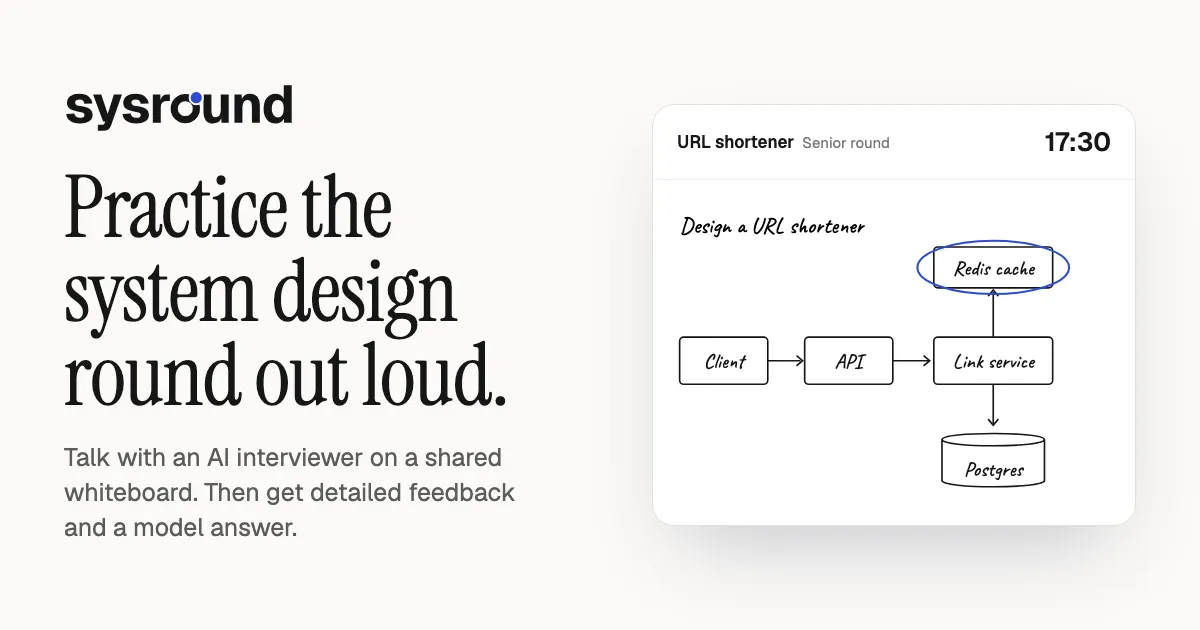
AI system design mock interviews. An AI interviewer named Alex runs a live spoken round with a shared whiteboard. Alex asks one question at a time, does not hand over the answer, reads the diagram as it is drawn, records agreed numbers in the candidate's notes and leaves comments on parts it intends to probe. Sessions run 45 or 60 minutes and follow an onsite-like agenda from requirements through wrap-up.
Scorecards and model answers. After a round, the platform returns a per-skill score across seven dimensions including problem framing, high-level architecture, technical depth, trade-offs, scale and reliability, navigation and ownership, and communication. Each score quotes the candidate's own words and drawings, and the report includes a model answer that starts from the candidate's own notes, a minute-by-minute whiteboard replay and a practice plan aimed at the weakest skills.
Machine learning and behavioral coverage. Beyond coding and system design, the library holds 965 machine learning questions covering models, data, metrics and ML systems, and 594 behavioral questions on conflict, failure, leadership and project narratives. Object-oriented design, practical engineering and product questions round out the catalog.
Level calibration. Mid, senior and staff tiers are modeled separately. The chosen level alters the bar applied by the grader, the difficulty of the deep dives and how directive the interviewer is during a round.
How They Work
The user journey begins with a company search on the home page or a jump into the study plans. From there, candidates either browse the free question library, open a problem in the workspace, or launch a mock interview at the practice entry point. No card is required to explore the library, company pages, plans or workspace.
A mock round follows a fixed six-stage agenda mirroring a 45 minute onsite session. Requirements occupy the first eight minutes, where Alex answers scoping and sizing questions in the manner of a product owner and writes the agreed points into the notes pane. Estimation follows from minute eight to twelve, covering peak requests per second, storage and read to write ratios. API and data model work runs from twelve to eighteen minutes, defining endpoints and tables, with access patterns driving the database choice. High-level design fills minutes eighteen to twenty-eight, drawing the main components and tracing a single request through them. Deep dives from minute twenty-eight to forty cover one or two hard parts chosen by the interviewer. The final five minutes handle failure at ten times the traffic plus the scorecard handover. A visible timer tracks remaining time and the interviewer signals when to move on.
Grading is deliberately repeated. The grader scores the round three times and uses the middle result, a design choice intended to damp variance in automated evaluation. Audio is routed to third-party AI providers for conversation and transcription, is not retained, and transcripts, whiteboards and scorecards remain visible only to the account holder.
Ideal Client Profile
A senior engineer preparing for a system design loop at a large platform company. A candidate two to four weeks out from an onsite at Meta or Amazon can work through the coding study plans for pattern fluency and reserve paid rounds for spoken design practice, where the value of live rehearsal is highest.
A mid-level developer moving up a level band. Someone targeting a first senior title benefits from the level selector, since the same prompt is graded against a different bar and the deep dives escalate accordingly. The scorecard gap between the current band and the target band makes the required jump concrete.
A machine learning engineer at an AI lab. Candidates facing model, data, metric and ML system design questions can draw on the 965 machine learning prompts and the ML system design subset, which sit alongside the general coding catalog rather than in a separate product.
A staff-level candidate returning to interviewing after several years. Engineers far from their last loop often need structure more than raw problem volume. The sequenced plans and the recorded whiteboard replay provide a reconstruction path without requiring a coach.
A bootcamp graduate or career switcher on a tight budget. The free tiers of the workspace, library and plans cover a substantial amount of ground, and credit packs let a cost-sensitive candidate buy one or two rounds rather than commit to a subscription.
Pricing & Engagement Models
The library, company pages, study plans and practice workspace are free. During the beta, each account receives two free rounds of 45 minutes. After that, rounds are bought in packs: a single round at 29 dollars, five rounds at 99 dollars (19.80 dollars per round) and twelve rounds at 199 dollars (16.58 dollars per round). There is no subscription, credits do not expire, and a round is deducted only when a session actually starts. Full terms appear on the pricing page. The model suits candidates who buy in bursts around interview cycles rather than paying monthly.
Editorial Assessment
SysRound is a focused product with clear strengths. The free layer is unusually generous, pairing a large attributed question library with a usable coding workspace and sequenced curricula. The AI interviewer is the differentiated piece: spoken turn-taking, whiteboard awareness and a seven-skill scorecard that cites the candidate's own words are meaningfully closer to a real round than a chat transcript. Transparent sourcing on questions and a repeated grading pass with a middle result suggest deliberate attention to reliability.
Limitations are real. AI mock interviews exist only for system design, so coding, machine learning and behavioral practice remain static question and answer work. Per-round pricing adds up for candidates running many loops, and reported question coverage varies by employer since attributions depend on public lists and candidate reports.
Best fit: engineers from mid-level to staff who want affordable spoken system design rehearsal with structured feedback. Candidates seeking full loop simulation across every round type, or human coaching with live critique, should look at broader alternatives.