
Overview
DataExpert.io Academy is an online training platform built around data engineering, analytics engineering, and applied AI skills. The organisation is led by Zach Wilson, identified on the site as founder, and it packages live boot camps, a self-paced content library, graded mock interviews, and a Discord community into a single catalogue. The platform reports more than 9,696 learners in its pipeline and frames its offer as a structured alternative to scattered tutorials and stale documentation.
Two paid formats carry the business. The flagship is a cohort boot camp, currently the Senior AI Analytics Engineering Boot Camp, priced at $3,000 with a scheduled start of November 16, 2026. The second is an all-access subscription at $96 per month that unlocks self-paced material and community access. Mock interview products sit alongside at $50 and above, with several free options. Instruction comes from working practitioners rather than career trainers, including a Solutions Architect Manager at Databricks, a data engineer at phData, the founder of Rebel Data Science, and a former Google software engineer.
No headquarters address is published, though live sessions run on Pacific time and the overall structure points to a United States base. Native iOS and Android apps extend the platform beyond the browser. Alumni are shown as working at OpenAI, Amazon, Meta, Netflix, Tesla, Salesforce, Robinhood, and Microsoft, which positions DataExpert.io Academy as a career accelerator for candidates targeting large technology employers rather than a broad general purpose course library.
Services & Expertise
Live Analytics Engineering Boot Camp. The flagship cohort covers Snowflake, dbt, Airflow, and AI agent tooling across a multi-week schedule of lectures and labs. Participants work through dimensional modelling, pipeline orchestration, and analytical layer design, finishing with a capstone that mirrors a production analytics stack. The outcome is a portfolio artefact plus a working command of the tools the instructors use in their day jobs.
All-Access Subscription. A monthly plan that opens the full self-paced catalogue and the Discord community. It suits learners who prefer to move at their own pace or who want to sample material before committing to a cohort. Access continues for as long as the subscription stays active, making it the lowest-commitment route into the wider curriculum.
Capstone Project Library. The Build stage of the curriculum is anchored by documented projects such as Real Time Formula 1 Analytics, Chess.com analytics, a cryptocurrency trading strategy, a sports betting application, and a streaming dataset exercise. Each follows a source to pipeline to transform to warehouse to dashboard path, so learners practise ingestion, transformation, modelling, and visualisation as one continuous exercise rather than as isolated lessons.
Mock Interview Gauntlets. Timed, role-specific interview simulations cover SQL under pressure, data modelling, system design, algorithms, and behavioural rounds. Submissions are graded the moment they are entered. Current listings include an analytics engineer data modelling gauntlet and a data engineer system design gauntlet, with some rounds offered free. The product is aimed at candidates who want rehearsal against realistic senior-level prompts rather than a generic question bank.
Practice SQL Environment. A query workspace inside the platform lets users run SQL against provisioned schemas, create their own schemas through a guided query, and work through a question library. It functions as a daily drill area and removes the friction of practising without a local warehouse setup.
Cloud Credential Onboarding. Rather than leaving environment setup to the learner, the platform provisions access to cloud services tied to a registered program. A dashboard onboarding flow activates access, and a profile field links a GitHub account so learners can pull the organisation's repositories. Databricks accounts are issued for hands-on work, according to student accounts.
Community and Live Delivery. Live lectures and labs run on Discord stages from 6 to 8 PM Pacific, with recordings posted within eight hours. Book club and teaching assistant sessions happen on Google Meet, and a schedule page collects the links. A newsletter and a discovery call route give buyers a lower-commitment way to engage before purchase.
How They Work
Engagement follows a linear path the platform labels in stages: explore, build, source, signal, trust, interview, and ship. A prospective learner starts with an email signup or a discovery call, then chooses between a cohort program and the subscription. Once enrolled, the dashboard presents an onboarding page for the registered program where cloud access is activated.
Environment setup happens in three steps. The learner runs a schema creation query inside the query page, activates cloud credentials from the dashboard, and records a GitHub username under social metadata so repository access can be granted. A Discord username is updated in the same profile area, which is how live sessions are joined. Timezone and email notification preferences are managed from the same page.
Delivery blends synchronous and asynchronous work. Live classes run two hours per evening on Pacific time and are recorded for later viewing, so learners outside the Americas rely on replays. Labs and capstones are self-directed, with teaching assistants reachable through scheduled sessions. Assessment is continuous through capstone submissions and, for interview preparation, through graded mock rounds that return feedback immediately after submission. Candidates who only want rehearsal can browse the mock interview catalogue independently of any program.
Ideal Client Profile
A working data engineer moving into AI-adjacent analytics. Someone already comfortable with SQL and warehouse concepts who needs structured exposure to Snowflake, dbt, and orchestration tooling. Practitioner instructors and provisioned cloud accounts remove the setup overhead that stalls self-directed learners.
An analyst targeting an analytics engineering title. Analysts who model data in spreadsheets or BI tools and want the transformation layer skills the role requires. The dbt and dimensional modelling content maps closely to that transition, and the capstone becomes a talking point in interviews.
A career switcher with an adjacent technical background. The curriculum is not pitched at beginners, and student commentary reinforces that. Candidates arriving from software engineering, statistics, or IT support find the pace manageable, while complete newcomers are likely to struggle in week one.
A senior candidate preparing for interview loops. Engineers with interviews scheduled at large technology firms can buy individual mock gauntlets instead of a full program. The timed, graded format mirrors real interview structure and costs a fraction of boot camp tuition.
A self-paced learner testing the water. Professionals unwilling to commit $3,000 upfront can start on the monthly plan, work through recorded material and the Discord community, and upgrade to a cohort later. Mobile apps support study during commutes and between meetings.
Pricing & Engagement Models
Pricing is published rather than quoted. The Senior AI Analytics Engineering Boot Camp lists at $3,000 for a scheduled cohort. The all-access subscription is $96 per month and covers self-paced content plus the Discord community. Mock interview gauntlets start at $50, with several rounds free of charge. A discovery call and a free newsletter provide no-cost ways to evaluate fit before spending.
The refund policy is unusually specific and worth reading closely. Subscription and self-paced products are non-refundable. Live boot camps carry a 25 percent processing fee for requests inside the first seven days, a 50 percent fee inside the first fourteen days, and no refunds after that window. Buyers should treat a cohort seat as a committed purchase rather than an extended trial.
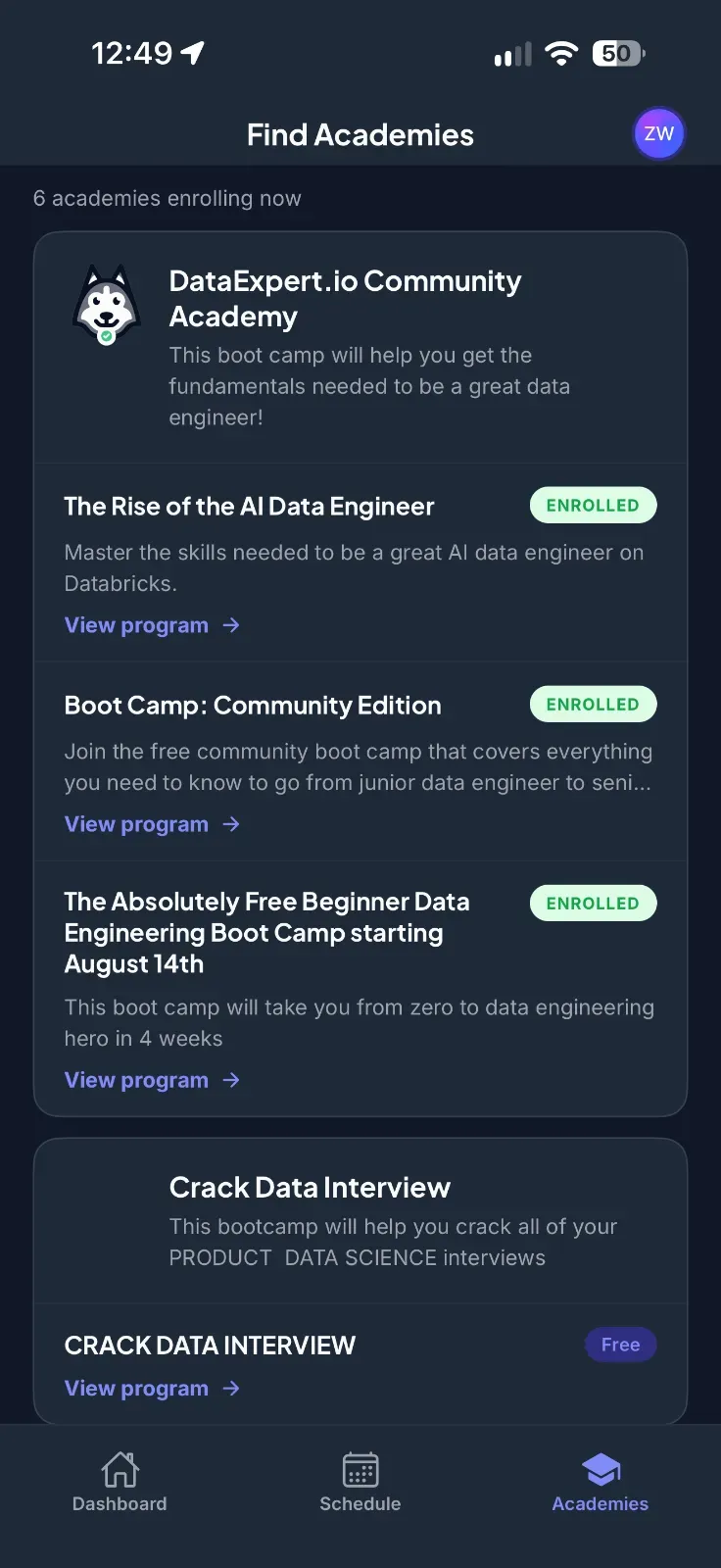
Engagement is direct to consumer, and no enterprise tier is advertised. Teams seeking cohort licensing, invoicing, or procurement paperwork would need to raise it during a discovery call, because the public flow is built around individual enrolment. Prospective students can browse the available programs to compare the self-paced and live options side by side.
Editorial Assessment
DataExpert.io Academy occupies a credible middle ground between cheap video marketplaces and expensive immersive boot camps. Its clearest differentiator is instructor pedigree combined with real cloud provisioning, which lets learners practise on Databricks and Snowflake rather than toy sandboxes. The graded interview products are a smart adjacency that few training providers offer at this price point, and the capstone library gives graduates something concrete to demonstrate.
The limitations are equally visible. The $3,000 cohort is a meaningful outlay with a refund window that narrows quickly, and self-paced access carries no refund at all. Live delivery on Pacific time disadvantages learners in Europe and Asia, pushing them onto recordings. The curriculum assumes prior technical fluency, so absolute beginners should look at foundations-first providers instead.
Best fit: practising engineers and analysts with two or more years of data experience who want structured, tool-specific depth and interview rehearsal. Poor fit: career changers starting from zero, or buyers who require enterprise procurement and invoicing. For the right candidate, live practitioner instruction combined with pay-per-interview flexibility makes DataExpert.io Academy a defensible investment.