
Overview
RemindHer is a family calendar and task management application designed to reduce the mental load that often falls on mothers and primary caregivers. The product combines a shared family calendar with voice-to-task capture, enabling couples to organize children's activities, household chores, and personal appointments in one central place. The website describes the service as a way to "stop remembering everything alone" and positions the app as a practical tool for distributing household responsibilities among family members.
The company behind RemindHer appears to be a small, purpose-driven team led by founder Adi Ben Elyahu. The service is offered in both English and Hebrew, reflecting an intent to serve international and Israeli families. The website includes typical marketing elements such as customer testimonials, feature highlights, and a contact page where interested users can request access or get started. Although no founding year is explicitly published in the HTML, the site includes references to "2026" in copyright and metadata, suggesting the current iteration is recent or actively maintained.
RemindHer's core value proposition is straightforward: instead of relying on one person to remember every detail of family life, the app creates a shared system where tasks, events, and reminders are visible to all members. The platform appears to target moms, couples, and families with children who need a more organized approach to daily logistics.
Services & Expertise
RemindHer provides a focused set of features centered on family coordination. The website highlights three primary capabilities, each designed to address a specific aspect of household management.
-
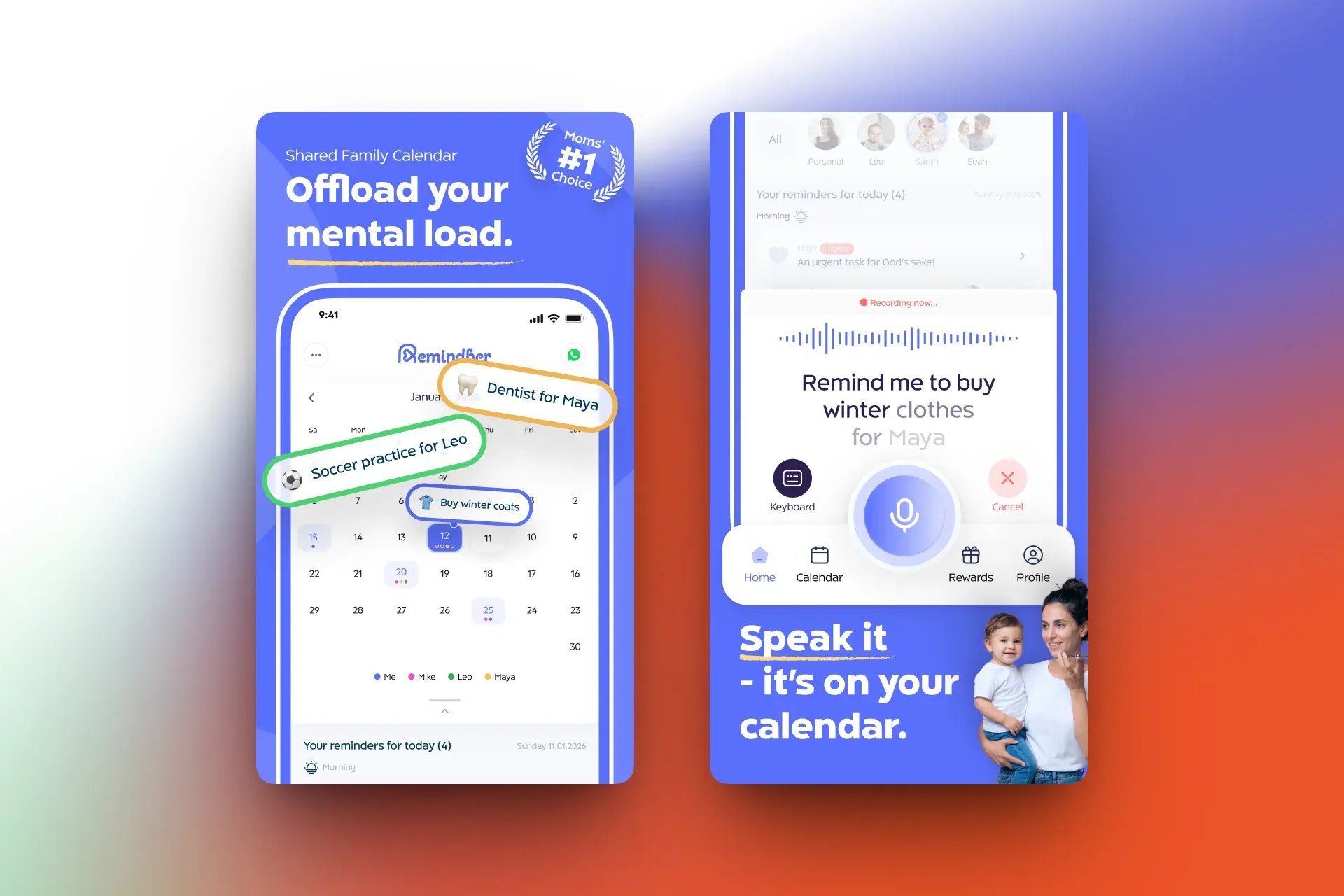
Voice-to-Task Magic: This feature allows users to dictate tasks by voice, turning spoken notes into actionable to-do items. The website describes it as a way to "transform voice notes into manageable tasks effortlessly," which is particularly useful for parents who are busy with children or other activities and cannot type out reminders. This capability reduces friction in capturing tasks, making it more likely that tasks will actually be recorded and completed.
-
Shared Family Calendar: The app includes a shared calendar that lets family members see each other's schedules and commitments. The stated goal is to "distribute household responsibilities among family members," ensuring that no single person is overwhelmed with the mental burden of keeping track of everyone's appointments and chores. This feature is intended to promote shared responsibility and reduce conflict over forgotten tasks.
-
Organize Kids & Tasks Easily: RemindHer is designed specifically for parents, with a focus on integrating children's schedules and related tasks into the family calendar. The website notes that it can "integrate and sync family schedules seamlessly," suggesting that the app can work alongside existing tools and user routines. This feature helps parents manage school pickups, extracurricular activities, pediatric appointments, and other child-related obligations in one place.
Beyond these three listed features, the website mentions a few supporting capabilities and differentiators:
-
Smart Calendar Integration: RemindHer claims to sync with Google Calendar, which allows users to maintain their existing calendar ecosystem while adding family-specific task management. The website emphasizes that this synchronization occurs "while maintaining privacy," a consideration for users who are sensitive about sharing personal information.
-
Shared Responsibility Model: Rather than keeping all household information in one person's head, the app encourages a collaborative approach. The site's copy repeatedly stresses the importance of sharing the mental load and making responsibilities visible to all members of the household.
-
Multilingual Support: With language alternates for English and Hebrew, RemindHer is accessible to a bilingual audience. This is a notable feature for families who communicate in both languages or who live in multilingual environments.
-
Testimonial Backing: The website includes customer testimonials from users like Michael Smith and Sarah Johnson, both of whom describe the app as transformative for their family management. While these are self-reported and not independently verified, they provide some social proof for the product's utility.
The website's "Features" page is linked as "Services" in the navigation, which suggests that RemindHer packages its software capabilities as a service offering. The company appears to be a software-as-a-service (SaaS) product rather than a consulting or development firm.
How They Work
Based on the website's structure, the user journey with RemindHer starts at the homepage, where visitors are invited to "Get Started" via a contact form. The process is not detailed in the HTML, but the navigation suggests a familiar SaaS funnel:
-
Initial Contact: A prospective user clicks the "Get Started" button, which directs them to the contact page. This implies that onboarding begins with a request, likely followed by a signup link or a demo invitation.
-
Account Setup: Once a family creates an account, they can set up a shared calendar and begin adding tasks. The app is designed to be used by multiple members, so each partner can participate in managing the schedule.
-
Task Capture: Users can use voice-to-task to quickly add items without typing. This can happen at any time, making it easy to capture reminders during busy moments.
-
Calendar Synchronization: RemindHer integrates with Google Calendar, allowing users to see their existing events alongside family-specific tasks. This reduces the need to switch between multiple apps.
-
Ongoing Usage: The shared calendar and task list become the central hub for family coordination. As tasks are completed, they can be checked off, and new tasks can be added by any member.
The website does not publicly list onboarding timelines or specific methodologies, but the product's simplicity suggests that it is designed for immediate adoption. The use of a contact page rather than a self-serve signup may indicate that RemindHer is in an early stage or that it prefers to onboard users with some guidance.
Ideal Client Profile
RemindHer is best suited for families and couples who experience the "mental load" problem, where one person, often the mother, manages most of the household's cognitive labor. Specific scenarios where the app would be valuable include:
-
A working mother with multiple children who needs to coordinate school runs, after-school activities, meal planning, and medical appointments. RemindHer's voice capture and shared calendar would help her delegate tasks to her partner and older children, reducing her need to track everything alone.
-
A dual-career couple that struggles with task visibility and communication. By using a shared calendar, both partners can see what needs to be done and who is responsible, minimizing arguments about forgotten tasks or uneven distribution of chores.
-
A family with a special needs child or a child with many appointments. The ability to sync with Google Calendar and organize child-specific tasks is particularly relevant for parents managing complex schedules and medical routines.
-
An Israeli or Hebrew-speaking family looking for an app in their native language. The bilingual support makes RemindHer accessible to a demographic that may not find comparable tools in Hebrew.
-
A family that uses Google Calendar as a central scheduling tool. Since RemindHer syncs with Google Calendar, it can serve as a layer on top of existing infrastructure, making adoption easier for families already invested in Google's ecosystem.
The app is targeted at consumers (B2C), not enterprises. Its focus on mothers and families means it is unlikely to replace a project management tool for work, but rather to complement family life.
Pricing & Engagement Models
The website does not publicly disclose pricing. The homepage includes a "Get Started" button that leads to a contact page, suggesting that RemindHer may be in a beta phase, offer a free trial, or require a signup inquiry before sharing pricing details. Given that the product is a consumer app, a subscription model is likely, with monthly or annual plans. Some family task apps use a freemium model, where basic features are free and premium features, such as voice capture or calendar sync, require a paid tier.
There is no mention of one-time purchases, enterprise licenses, or consultation fees. The "Get Started" and "Contact" pages indicate a direct-to-consumer sales process rather than a reseller or partner model. Early adopters may receive personalized onboarding, which would be consistent with a young startup offering high-touch support to build its initial user base.
Why Consider Them
RemindHer differentiates itself by focusing specifically on the mental load of motherhood and family management. Unlike generic calendar apps, it is built around the concept of shared responsibility and reducing the burden on one person. The voice-to-task feature addresses a real pain point for parents who need to capture tasks quickly during chaotic moments. The integration with Google Calendar provides a practical bridge for users who are not willing to abandon their existing calendar system.
The company's bilingual English/Hebrew support is a unique feature in this niche, potentially giving it an edge with Israeli families and Hebrew-speaking users worldwide. The founder-led, purpose-driven narrative adds a personal touch to the brand, which may appeal to users looking for a product built by someone who understands the challenges of family management.
However, the product is still relatively unknown, and the website lacks detailed technical documentation, security policies, or independent reviews. Prospective users should evaluate whether the app's current feature set meets their specific needs, particularly if they require extensive customization or advanced integrations.