Overview
CiteTrue is a free, AI driven citation checker and academic source verification platform for researchers, students, editors, and faculty who need to confirm that every reference in a manuscript points to a genuine publication. Operated from citetrue.com, the service cross-references submitted reference lists against authoritative scholarly databases and returns a confidence score for each entry, flagging citations that appear fabricated, misattributed, or generated by large language models. It serves the academic publishing ecosystem rather than one institution, spanning graduate students preparing dissertations, journal editors screening submissions, peer reviewers evaluating manuscripts, and professors supervising student work. CiteTrue is delivered as a web application supported by a Chrome extension and a Mac desktop app. The company reports that more than 30,000 students and researchers have used the service, and the interface is localized into eleven languages.
Services & Expertise
CiteTrue bundles a reference verification engine with a small family of academic writing utilities, all reachable from a single account. The product pages describe the following capabilities.
-
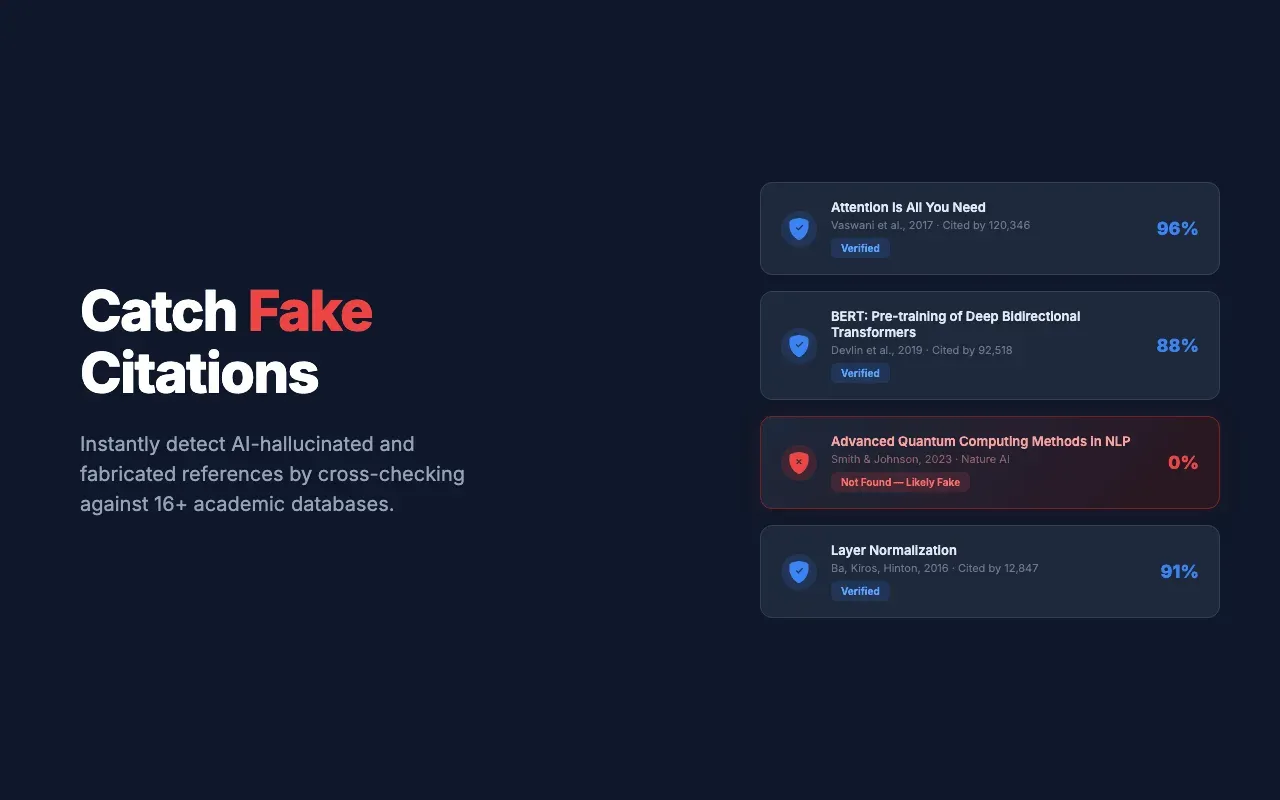
Citation Checker. The flagship tool accepts a pasted reference list in any common style and verifies each entry against indexed academic records before returning a confidence score per citation. Entries that cannot be matched to a real publication are marked as not found, while partial matches are reported together with the specific field that disagrees.
-
Citation Finder. This is the inverse of the checker. It takes a paragraph of prose and returns real, peer reviewed sources that support each claim in it, which suits authors who are still assembling evidence rather than auditing a finished bibliography. The company positions it as a way to source genuine literature instead of asking a general purpose chatbot for references.
-
Paper Draft. A drafting assistant that produces a section of text from a topic and, according to the site, ties every sentence to a real peer reviewed source. Its stated purpose is to remove the step where authors invent plausible looking references to fill gaps in a draft.
-
AI Humanizer. A rewriting utility that converts machine generated drafts into prose that reads more naturally. It sits alongside the citation tools as a polishing stage for manuscripts that were partly composed with AI assistance.
-
Deep Verify mode. The platform separates a standard Fast verify pass from a Deep Verify pass that consumes five credits per reference. Deep Verify is recommended when a reference list is too structurally irregular for the faster parser, or when the stakes justify a slower retrieval and comparison cycle.
-
Field level matching. Rather than confirming only that a title exists, CiteTrue separates each reference into title, authors, year, DOI or identifier, and venue details such as volume and pages. Every field is compared against the matched record, which catches the common case of a citation that points at a genuine paper while carrying a wrong year, wrong author order, or invented DOI.
-
Browser extension and Mac app. A Chrome extension and a macOS application extend verification beyond the website tab. Both are listed as official apps in the site footer, which suggests the company intends the checker to sit inside an existing writing or reviewing workflow rather than require a separate visit.
-
Broad database coverage. The verification layer draws on a mix of primary databases, aggregators, and publisher indexes. Named sources include arXiv, CORE, Crossref, Google Scholar, OpenAlex, ResearchGate, ACM, BMC, Cambridge University, Elsevier, IEEE, OpenLibrary, PubMed, ScienceDirect, Semantic Scholar, Springer, and Wiley, plus additional paid sources that the company does not name.
-
Multilingual interface. The product is localized into eleven languages, among them French, German, Italian, Spanish, Portuguese, Russian, Arabic, Chinese, Japanese, and Korean, each with its own localized URL. That breadth points to an international user base rather than a single national market.
How They Work
CiteTrue is browser based and requires no installation to begin. A user signs in with Google, email, or phone, then pastes a reference list into the verification panel. The published pipeline runs through a defined sequence: text entry, citation splitting, placement into a task queue, queries against multiple databases, analysis of the returned results, follow up queries against additional databases where needed, aggregate analysis, and finally generation of a report. Each stage runs automatically once the reference list has been submitted.
The engine decides how to treat the input before verification starts. If it detects in text citations rather than a reference list, the interface warns the user and switches to search mode. If no citations are detected at all, or if the pasted content is not a valid reference list, the system says so and points the user toward the search feature instead. When a reference list is structurally too complex for the fast parser to read reliably, CiteTrue recommends either Deep Verify, at five credits per reference, or reformatting the text as a standard numbered or bulleted list.
During verification the tool normalizes citation formatting automatically, so inconsistencies in style do not block the check. Results arrive as a report with per reference confidence scores, and citation checking on dozens or hundreds of entries can be triggered in a single pass. Typical turnaround is measured in seconds to minutes rather than days, which matters for authors working against a submission deadline. Multi factor context such as the credit balance is surfaced in dialog form, and a referral flow grants bonus credits to both parties when an invited colleague registers.
Ideal Client Profile
CiteTrue is built for people who carry responsibility for the accuracy of a bibliography and cannot manually audit every entry.
-
Doctoral candidates with long reference lists. A PhD student in computer science assembling a thesis with hundreds of citations faces a manual check that is not realistic. Batch verification surfaces entries that do not exist and spares the candidate a reviewer challenge or a correction notice.
-
Journal editors screening submissions. An editor handling a high volume of manuscripts needs to filter out papers with bogus references at the initial screening stage. Running the full reference list through the checker lets an editorial office triage before assigning reviewers.
-
Peer reviewers and thesis advisors. A reviewer or supervisor who signs off on a manuscript carries reputational exposure if fabricated references slip through. Verification before review reduces the chance of an inadequate assessment being attributed to the reviewer.
-
Undergraduate and master's students. A student writing a course paper often worries about citation formatting and unreliable online sources. The checker confirms that a source exists and that the details match, which is useful for coursework with a strict style requirement.
-
Research groups preparing grant or journal submissions. A laboratory finalizing a manuscript can run every reference through the service as a last integrity pass before submission, using the confidence scores as an internal quality gate.
Pricing & Engagement Models
The service is credit based with a free entry point. The homepage advertises a daily allowance of free citation checks, and the credit dialog states that a specific number of credits equals a defined number of citation checks, alternative source searches, or Citation Finder drafts. A referral program awards credits to both the inviter and the new registrant, and bonus credits are added automatically when an invited colleague signs up.
Consumption varies by mode. Standard Fast verify is the default, while Deep Verify is priced at five credits per reference, reflecting the heavier retrieval work involved. A dedicated pricing page exists in the site navigation, and a logged in dashboard tracks history and remaining balance. The landing pages analyzed do not publish a full tier table, so prospective institutional buyers would need to consult the pricing page or the sales contact for volume terms.
Why Consider Them
What separates CiteTrue from a plain reference lookup is the granularity of its checking. Splitting each citation into title, authors, year, identifier, and venue fields, then comparing every field against the matched record, catches the class of error where a real paper is cited with the wrong year or the wrong author list. The verification layer also spans a notably wide set of databases, from PubMed and Crossref to IEEE, Springer, Wiley, and Semantic Scholar.
The company supports its positioning with peer reviewed evidence rather than anecdote, citing research on fabricated GPT generated references, incorrect reference components in AI assisted medical papers, and record retraction volumes. Free daily checks, eleven language localizations, a browser extension, and a Mac app lower the barrier to adoption for individuals and small editorial teams, while the testimonial set spans undergraduates, doctoral students, professors, and journal editors.
Final Assessment
CiteTrue occupies a focused niche in academic integrity tooling. It is not a plagiarism detector and not a reference manager. It is a verification layer that answers a narrow question about whether each cited work exists and whether the accompanying details are correct. For departments, journals, and individual researchers already alert to AI generated reference fabrication, that narrowness is the point. Organizations evaluating it should confirm database coverage for their discipline, particularly for non English language scholarship, and review the credit economics against expected submission volume.