
Overview
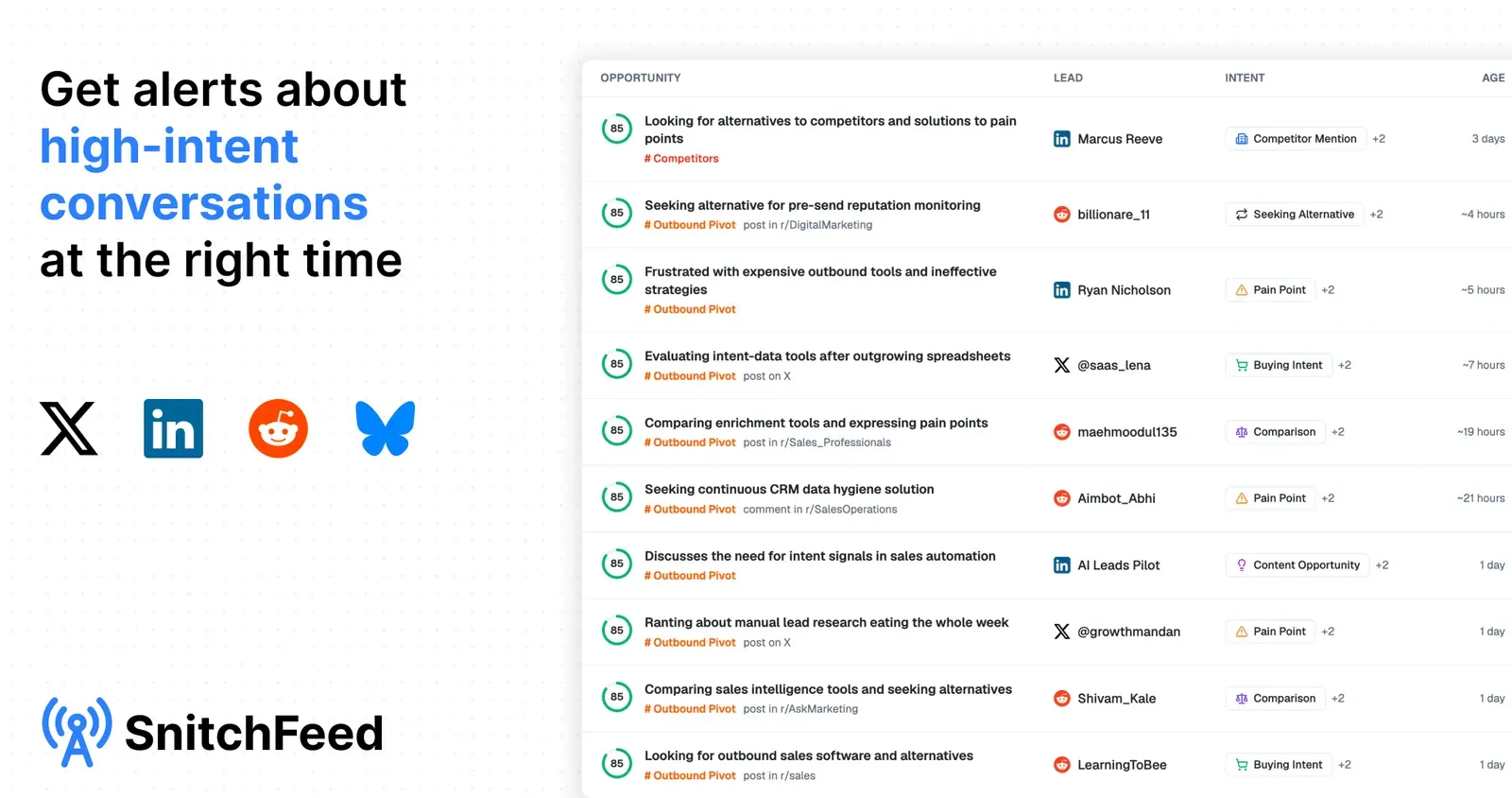
SnitchFeed is an AI-powered social listening platform built for go-to-market teams at startups and small to midsize businesses. Rather than working from purchased contact lists, the platform monitors public conversations across LinkedIn, X, Reddit, Bluesky, and Hacker News to surface buying intent as it appears. The underlying premise holds that a prospect publicly asking whether a tool exists for a specific problem sits considerably further down the funnel than a name drawn from a static database.
The service is operated by Incentyvise LLC and markets itself to B2B SaaS founders, sales leaders, and content teams. Its interface revolves around describing an ideal customer profile in plain language, after which the system watches for matching posts and comments around the clock. Coverage of GitHub, dev.to, YouTube, and newsletters is listed as forthcoming at the time of writing. Published customer logos include Databox, Wiza, Clerk, Mintos, Influx Data, Superthread, and Youform.
Services & Expertise
Intent-Based Social Listening The foundation of the product is always-on monitoring of public posts and comments that signal commercial intent. The platform is designed to catch phrases such as requests for tool recommendations and route them to the user before competing vendors respond. Monitoring runs continuously rather than through scheduled batch queries.
Natural Language ICP Definition Users describe their ideal lead in ordinary sentences instead of assembling filter trees by hand. Job titles, industries, company profiles, and descriptive phrases can all be expressed conversationally. The system automatically excludes job postings, promotional posts, and unrelated noise from results.
AI Relevance and Sentiment Scoring Every matching mention is evaluated by AI for relevance, buying intent, and sentiment before it reaches the user interface. Keyword hits that do not represent genuine purchasing signals are dropped from the feed. Sentiment tagging applies to each mention, which supports both pipeline work and reputation tracking.
Boolean Keyword Targeting The platform supports AND, OR, and NOT operators so users can define precisely which conversations they want and which they want excluded. This gives teams surgical control over tracked terms and complements the natural language approach. Off-topic threads, promotions, and recruitment posts can be filtered out systematically.
Real-Time Alerts and Notification Channels Matches can be delivered through Slack, Discord, email, or webhook depending on team preference. The product supports both instant pings and consolidated digest summaries. Starter accounts receive email, Slack, and Discord alerts, while webhook automations begin at the Pro tier.
Webhook Automations and CRM Routing SnitchFeed fires a webhook the moment a match lands, allowing leads to be routed into a CRM, an outreach sequence, an automation platform, or an internal tool. Documented destinations include HubSpot, Salesforce, Notion, Zapier, and Make. Any endpoint that accepts a webhook can be connected.
Noise Controls Users can block domains, exclude specific authors, apply engagement thresholds, and mute recurring false positives. These rules are configured once and then applied persistently. The feature set addresses a common complaint about keyword monitoring tools producing volume without precision.
Instant Historical Results Historical data is streamed into the account in real time, so a first session surfaces leads that already exist in the wild. Teams are not required to wait for new posts to accumulate before seeing value. Marketing materials claim first matches within roughly sixty seconds of signup.
Multi-Platform Coverage and Upcoming Sources Five channels are live: LinkedIn, X, Reddit, Bluesky, and Hacker News. Each has a dedicated monitoring page on the website. GitHub, dev.to, YouTube, and newsletters are displayed as planned additions rather than active integrations.
API and MCP Access Both the Starter and Pro tiers include API access as well as MCP availability, which allows the product to be wired into agentic workflows and custom internal tooling. This positions SnitchFeed beyond a dashboard-only product for technically capable teams.
How They Work
The engagement model is self-serve and product-led. A prospective user can begin with a seven-day free trial that requires no credit card, or book a demo through the site's navigation. The signup flow asks for either a plain-language description of the ideal customer or a company domain, and the domain option can infer a profile automatically.
From there, the platform scans continuously across the connected sources. The vendor states that a first set of matches typically appears within sixty seconds, with full setup achievable in about five minutes. Users then refine intent definitions, tune listeners, summarize mentions, and configure alerting rules inside the dashboard.
Delivery is handled through the notification channels the team selects. Email, Slack, and Discord are available on entry-level plans, while webhook delivery and workflow automations unlock at the Pro level. A sticky call-to-action bar and a persistent free-trial prompt sit throughout the marketing site, reinforcing the low-friction entry point.
Ideal Client Profile
A seed-stage B2B SaaS founder with no sales team. A solo founder needs pipeline without hiring a prospecting agency and can define an ICP in a sentence, then respond to relevant posts directly. The Starter tier's single user seat matches this profile closely.
A competitive displacement team at a growing software company. Companies looking to capture users frustrated with an incumbent can monitor complaint language about rival products and join those threads early. This is the platform's stated competitive use case.
A product marketing lead hunting for roadmap evidence. Teams that want to stop guessing which features to build can mine real conversations where users describe unmet needs. Shipping against documented demand reduces wasted development cycles.
A brand or communications manager watching for reputational risk. Catching negative mentions within minutes rather than days allows a public, fast response that can convert an angry customer into an advocate. Sentiment scoring supports this workflow directly.
A content strategist seeking distribution channels. Content teams can identify live discussions where their expertise is relevant and contribute to threads already attracting attention, which is a lower-cost acquisition path than paid distribution.
Pricing & Engagement Models
SnitchFeed uses a subscription model with annual and monthly billing options. The Starter plan is priced at forty-seven dollars per month when billed annually at five hundred sixty-four dollars, or fifty-nine dollars month to month, and includes seven thousand credits, ten tracked terms and profiles, three listeners, one user, three months of data retention, and API plus MCP access. Webhook automations and CSV exports are not included.
The Pro plan is priced at ninety-five dollars per month billed annually at one thousand one hundred forty dollars, or one hundred nineteen dollars monthly, and raises limits to twenty-one thousand credits, thirty tracked terms, ten listeners, five users, and six months of retention. It adds webhook automations, CSV exports, and ten workflow slots. A Custom tier starting at three hundred ninety-nine dollars per month offers multiple workspaces, custom data pipelines, custom integrations, and configurable limits.
Why Consider Them
The product differentiates itself by targeting intent rather than keyword volume, a distinction that matters for teams already overwhelmed by alert fatigue. Its plain-language setup lowers the technical barrier that typically accompanies boolean-heavy listening tools. Webhook-first architecture makes it integrable into existing CRM and automation stacks without heavyweight implementation.
Pricing sits at the accessible end for a category often dominated by enterprise contracts, which suits its startup and SMB audience. The vendor also maintains an extensive comparison page set against alternatives such as Octolens, F5Bot, GummySearch, ReplyGuy, Syften, and Awario, signaling a deliberate challenger position. Independent directory badges from ToolBit, Best Free AI Tools, SourceForge, and Slashdot appear in the footer. The main caveats are that monitoring is limited to public conversations and that several advertised sources remain unreleased.