
Overview
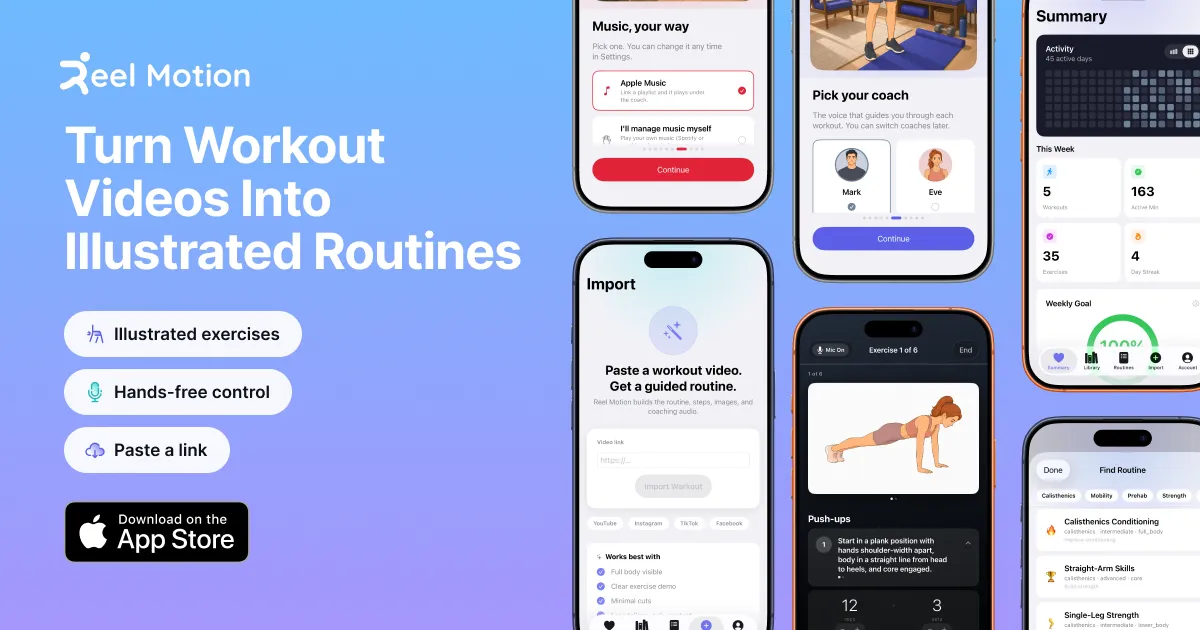
Reel Motion is an iOS fitness application that converts workout videos from YouTube, Instagram, and TikTok into illustrated, step-by-step exercise routines. Rather than maintaining a fixed catalogue of classes, the app takes a pasted video link and returns a structured workout that can be followed on an iPhone or iPad without pausing, rewinding, or writing notes. The product competes in the consumer health and fitness segment and is aimed at people who already collect training clips from social platforms but find video playback awkward to follow mid-session.
The website describes an Apple-first product: native iPhone and iPad support, a sync layer that keeps routines consistent across both devices, and direct export into Apple Health. Three ideas carry the marketing message, namely illustrated start and finish positions for every movement, a spoken coach that narrates each step, and voice commands that keep the phone on the floor. The page carries a 2026 copyright notice and credits the site build to In Motion Marketing. Commercial access is subscription based and priced in US dollars.
Services & Expertise
Video link import. Reel Motion accepts a shared link from YouTube, Instagram, or TikTok and reads the footage to identify the exercises inside it. The site states that imports are unlimited on every tier, so there is no monthly cap on how many videos a subscriber can process. This import-first model is the core of the product and separates it from apps that supply their own fixed catalogue of classes.
Illustrated exercise reference. Each movement arrives with drawn start and finish positions rather than a still frame pulled from the source video. Subscribers can request illustration redraws without an additional charge, which matters when a pose is ambiguous in the original clip. The drawings act as the reference layer while a workout is running and the screen sits at arm's length.
Guided workout player. The player presents one exercise at a time with step-by-step written instructions and timers, then advances through the routine in order. Because the sequence is broken into discrete steps, the source video does not need to be paused or scrubbed. The site positions this as the difference between watching a workout and running one.
Coach audio. A spoken coach reads each step aloud while background music keeps playing. Audio guidance allows attention to stay on form instead of the screen, and it is presented as a companion to the written steps rather than a replacement for them. The feature is included in every plan.
Hands-free voice control. Subscribers can say start, next, or done to move through a routine without touching the device. The website frames this around a phone propped on a stand or left on the floor during a session. It is the most operationally distinctive capability listed on the page.
Apple Health integration. Completed sessions are written directly into Apple Health, so workout minutes and activity history remain in one place alongside other tracked data. No manual logging step is described. This suits users who already rely on Apple health data as their single record.
Routine library. The app includes a browsable library of routines other people have imported, and subscribers can also assemble a routine from scratch. The library functions as a discovery layer on top of the import tool. It gives new users a starting point before they paste a link of their own.
Progress tracking and cross-device sync. Weekly minutes, streaks, and session history are tracked inside the app, and routines stay aligned between iPhone and iPad. Progress data answers the basic question of whether training is consistent. Sync means a routine built on one device is available on the other without being rebuilt.
Family Sharing support. Family plans begin at $7.99 per week and can be shared with up to six people through Apple Family Sharing. This extends the product from a single-user tool to a household arrangement. It is the only multi-seat option mentioned on the site.
How They Work
The user journey is deliberately short and is documented as three steps on the homepage. First, a link is shared from YouTube, Instagram, or TikTok, and Reel Motion pulls the exercises out of the video. Second, the workout is run one exercise at a time with illustrations, timers, and spoken coaching. Third, results are reviewed through weekly minutes, streaks, and session history, with finished sessions sent to Apple Health.
Onboarding is handled inside the app rather than through a sales or account management process. There is no consultation, no implementation phase, and no human account team described. A subscriber downloads the app from the App Store, selects a billing period, and can import a first video within minutes. Setup guidance on the website is limited to a single practical instruction, which is to prop the phone on a stand, press start, and follow along.
Processing time for an individual import is not published, and the site does not describe how accurately a routine is reconstructed from an ambiguous clip. The stated remedy for imperfect illustrations is the unlimited redraw option rather than a manual editing workflow. Support is offered by email at support@reelmotion.fit, with separate addresses for general feedback and press enquiries. Documentation, video tutorials, and a structured help centre are not referenced on the homepage, although a dedicated support page does exist.
Ideal Client Profile
A home exerciser with a saved backlog of social clips. This is someone who bookmarks workouts on Instagram or TikTok but rarely returns to them because replaying video mid-set is disruptive. Importing the link converts that backlog into routines that can be run in sequence from a single device.
A traveller or hotel room trainer. A subscriber who trains in unfamiliar spaces with limited equipment and needs the phone propped nearby. Voice commands and coach audio remove the need to reach for the screen between sets and between rounds.
An Apple Health user consolidating activity data. A user who tracks everything through Apple's ecosystem and wants imported workouts counted alongside walking, cycling, and other recorded activity. HealthKit export removes the manual logging step entirely.
A household sharing one subscription. Two or more people training at home who want the same application without separate purchases. Family Sharing covers up to six people on a plan starting at $7.99 per week.
A follower of specific fitness creators. A user loyal to a particular coach or channel rather than to a training app. Reel Motion does not replace that creator, it converts their content into a format that is easier to follow, which suits audiences that already trust a given source.
Pricing & Engagement Models
Reel Motion uses a subscription model with three billing periods, all priced in US dollars. The weekly plan costs $4.99 per week and is described as suitable for a single training block. The monthly plan costs $19.99 per month with no commitment beyond the current cycle. The annual plan costs $59.99 per year, described as roughly $5.00 per month and a 75 percent saving against the weekly rate. Family plans start at $7.99 per week and can be shared with up to six people through Apple Family Sharing.
The website states that every plan unlocks the whole application, so the tiers differ only in billing period and effective price rather than in features. Included across all plans are unlimited video imports, illustrated exercises, unlimited illustration redraws, the guided player, coach audio, hands-free control, and iPhone to iPad sync. Purchases are completed through the Apple App Store link carried on the site.
Why Consider Them
Reel Motion approaches fitness software from the import side rather than the content side. Its distinguishing claim is that an existing workout video, regardless of who produced it, can become a followable routine, which is a materially different proposition from an app that sells its own class library. The hands-free layer, combining voice commands with spoken coaching, addresses the practical friction of touching a phone mid-exercise, and Apple Health export plus iPhone to iPad sync keeps the product inside an ecosystem many users already run.
Two honest caveats sit alongside those strengths. The product is Apple only, with no Android, web, or watch experience described anywhere on the site. The testimonials published on the homepage are explicitly marked as placeholders with fictional names, so independent user validation is not yet available on the site itself.