
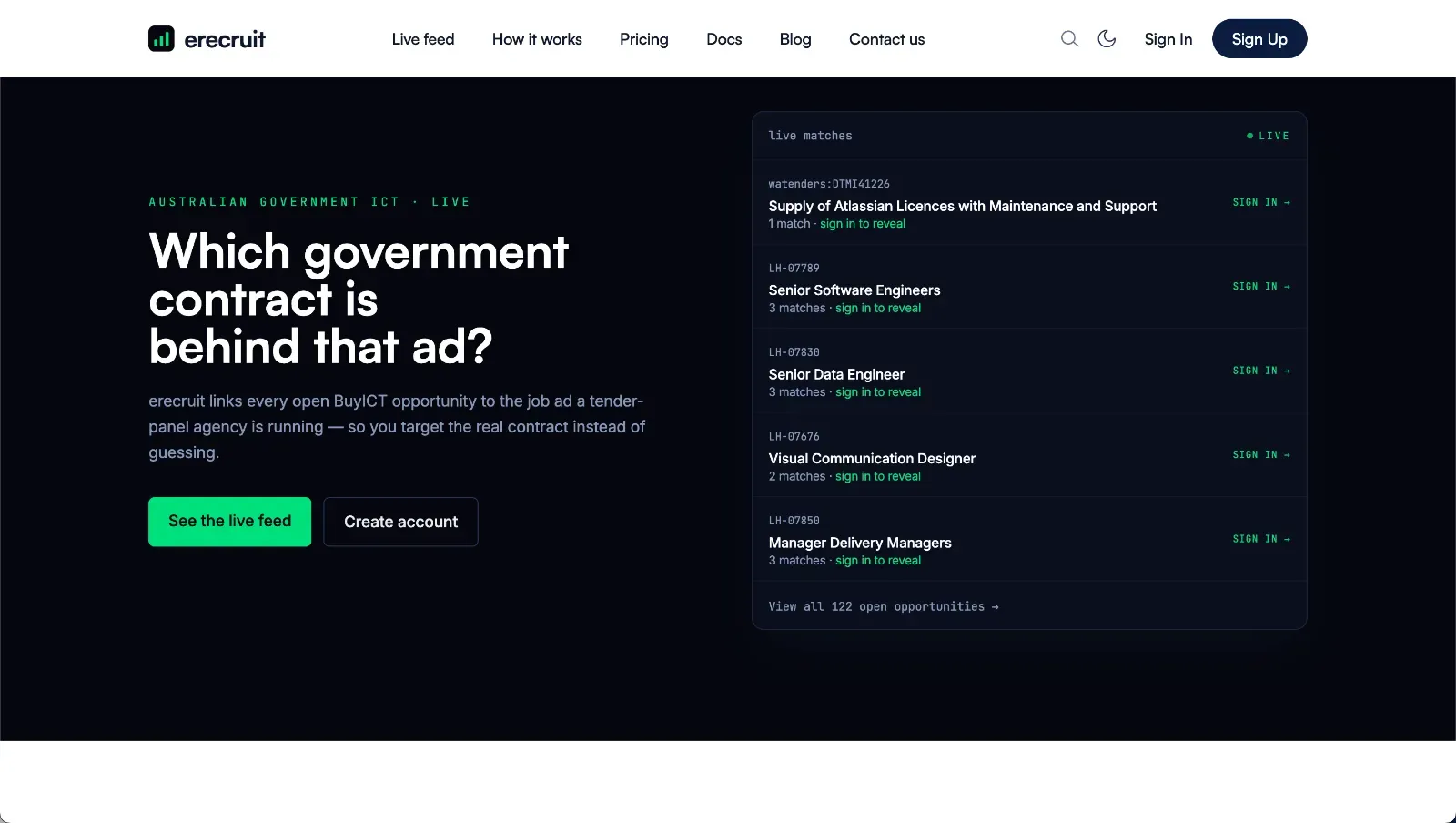
Australian government ICT recruitment runs on a specific information asymmetry. A tender panel agency holds a position on a government panel, receives a labour hire request, publishes an advertisement, and the contract sitting behind that advertisement usually remains invisible to agencies outside the panel. erecruit is a software platform built to close that gap for Australian recruitment desks. The product positions itself as government ICT opportunity intelligence: it takes each open opportunity published through BuyICT and links it to the agency advertisement running behind it, so a consultant can work the real contract rather than a guess.
Overview
erecruit is an Australian software product serving the recruitment industry, specifically agencies and labour hire providers that place technology contractors into federal and state government work. Its stated purpose is narrow and deliberate. BuyICT publishes labour hire opportunities the moment they open, and erecruit maintains a live feed of those opportunities, listing well over one hundred open positions at the time of review, alongside a separate view covering recently closed opportunities. Where the platform differentiates itself is in the linkage layer. Each opportunity in the feed is matched to the agency job advertisement that corresponds to it, with the supporting evidence being role type, security clearance, location and timing.
The company describes itself as government ICT opportunity intelligence, a label that maps closely to how the product actually behaves. There is no attempt to be a general purpose applicant tracking system for every sector. Everything visible on the platform sits inside the government labour hire workflow, from opportunity discovery through candidate matching, consent and pipeline progression. Navigation covers a live feed, a how it works section, pricing, documentation, a blog and contact channels, alongside audience specific pages for government buyers and recruitment agencies.
Headquarters are implied to be Australia through the emphasis on Australian government procurement, although the site does not publish a street address or a founding year. Team size is not disclosed either. What can be observed is the product surface itself: a modern web application with authentication, a workspace model, sign in and sign up flows, and a footer linking to support, press, privacy and terms pages. That combination suggests a small, product led organisation rather than a large enterprise vendor. Within its market segment, erecruit competes less with mainstream recruitment software and more with the manual process of cross referencing procurement notices, panel lists and job boards by hand.
Services & Expertise
Government opportunity intelligence. The foundation of the platform is a curated feed of open Australian government ICT opportunities. Entries are identified by their procurement reference, such as a watenders or LH identifier, and paired with the opportunity title. Each record displays how many advertisement matches have been found, with the actual matches gated behind authentication. A companion view covers recently closed opportunities, which supports post mortem analysis of which agencies were buying and which technical roles were in demand.
Tender to advertisement linkage. This is the capability that defines the product. Rather than presenting an opportunity in isolation, erecruit ties it to the agency advertisement running behind that contract. The linkage is justified with evidence drawn from the role, the required clearance level, the work location and the timing of both the procurement notice and the advertisement. For a recruiter, the outcome is a direct answer to the question of which agency is chasing which contract, which in turn indicates where a candidate submission is most likely to be useful.
CV matching with scored evidence. Recruiters upload candidate CVs into the workspace and the platform scores them against individual roles. Crucially, each score arrives with the reasoning behind it rather than as an unexplained number. That makes the output reviewable, because a consultant can see why one candidate was rated highly for a senior software engineering role and why another was rated lower, then decide whether to adjust the presentation of the CV before submission. A dedicated CV matching documentation section indicates the feature is treated as a core capability rather than a side utility.
Candidate search and import. Beyond CVs already held in the workspace, the platform provides discovery of candidates from external sources and allows them to be imported and cached inside the workspace. Caching matters for a busy desk because it removes the need to repeatedly revisit source platforms and gives the team a stable record to work from when building a shortlist against a specific opportunity.
Pipeline kanban management. Candidates move through stages on a kanban board, and the board can be filtered by opportunity. The practical effect is that a consultant can open a single government contract and see every candidate in play against it, from first contact through to placement, without maintaining a separate spreadsheet for each role. Stage progression is visual and drag based, which keeps the workflow close to how agency consultants already think about a desk.
Consent gate for representation. Before a candidate is submitted, the platform requires representation consent to be requested and recorded. Consent workflows are a persistent compliance concern in Australian labour hire recruitment, and building the gate into the submission path rather than treating it as an afterthought reduces the risk of a submission proceeding without documented permission.
Recruiter dashboard. A dashboard consolidates the operational picture: key performance indicators, current CV matches, items flagged as needing review, and recent activity. For team leads, this offers a way to monitor desk activity without chasing status updates, and for individual consultants it acts as a daily worklist.
Market briefings and documentation. The site maintains a weekly briefings section, a blog and product documentation covering topics such as how the platform works and how CV matching is performed. These materials serve both as onboarding aids and as a lightweight intelligence layer about activity across government ICT hiring.
How They Work
The engagement model follows the natural order of an agency desk. A recruiter creates an account, and from that point the live feed becomes the entry point. Opportunities appear as BuyICT publishes them, each carrying its procurement reference, title and a count of linked advertisements. Signed in users can reveal the specific matches, which is the moment the platform converts a public procurement notice into an actionable commercial lead.
Once an opportunity is selected, the workflow turns to candidates. CVs are uploaded and scored against the role, with the rationale displayed alongside the score. Where the workspace lacks suitable candidates, the search and import tools bring in external profiles, which are then cached locally. Selected candidates move onto the kanban board and are progressed through stages while the system tracks their position against the originating opportunity.
The final step before submission is consent. The platform requests representation consent from the candidate and records it, so that the submission is backed by documentation. Throughout the process, the dashboard aggregates matches, review items and activity, giving consultants and team leads a shared view of the desk. The sequence is deliberately linear: find the contract, prove the match, secure consent, submit. The marketing material frames this as four moves, from opportunity going live through linking, scoring and pipeline management, which is an accurate reflection of the product's structure.
Technically, the application is delivered as a modern web platform with account authentication, a workspace boundary for cached data, and browser based interface elements including a notification layer and progress indicators. No public API documentation or integration catalogue is visible from the homepage, so teams should assume the platform is used as a standalone destination rather than as a component inside an existing stack.
Ideal Client Profile
A boutique technology recruitment agency holding one or two government panels. These firms win panel positions but lack the analyst capacity to monitor BuyICT daily and cross reference advertisements by hand. The opportunity feed and the linkage layer do that work automatically, and the resulting intelligence is directly usable by a desk of two to ten consultants.
A mid sized agency scaling its government ICT practice. Where a firm is adding consultants to a public sector desk, the dashboard, kanban and scoring features standardise how that desk operates. New hires see the same pipeline, the same evidence based scoring and the same consent gate, which reduces variation in how submissions are prepared.
A recruitment consultant moving from commercial to government work. Government hiring has its own vocabulary of clearances, panel arrangements and procurement references. A consultant new to that environment benefits from seeing the opportunity and the advertisement side by side, because it teaches the structure of the market while delivering leads at the same time.
An agency with a deep candidate bench but shallow lead flow. Firms that have invested in candidate relationships but struggle to identify which contracts are genuinely open will find the feed and the match counts more valuable than any sourcing feature. The platform converts latent candidate supply into targeted submissions.
A labour hire provider assessing which agencies to partner with. The recently closed opportunities view and the buyer and agency directories provide a picture of purchasing patterns. Business development teams can use that to prioritise partnership conversations with agencies that are consistently active in a given technology category.
Pricing & Engagement Models
Pricing is published rather than hidden, which is unusual in a market where many recruitment tools push prospects toward a sales call. The pricing page sets out plans, and the product is subscription based, consistent with a software as a service model where value accrues from continuous daily access to a live feed. Trial access is available through account creation, and the sign up flow is open to any recruiter without an obvious gating conversation.
Engagement is therefore self serve rather than project based. There is no evidence of custom consulting engagements, fixed price implementation packages or managed service offerings. A prospective customer signs up, works within a workspace and pays on a recurring basis. For agencies comparing options, the practical evaluation is whether the volume of matched opportunities justifies the subscription relative to the manual research time it replaces.
Editorial Assessment
erecruit occupies a genuinely narrow niche and executes against it with clarity. The strongest aspect is the specificity of the value proposition. Linking a procurement opportunity to the advertisement behind it is a discrete, verifiable function that saves research time and sharpens targeting. Scoring CVs with visible reasoning rather than opaque rankings is a thoughtful design choice, as is the inclusion of a consent gate inside the submission path.
Limitations are equally clear. The platform is confined to Australian government ICT labour hire, which means agencies with broader commercial practices will still need other tools. The absence of published team, founding and location details makes vendor due diligence harder than it would be with a more transparent corporate presence, and no public integrations or API are advertised, so it is unlikely to slot neatly into an existing technology stack.
The best fit is an Australian recruitment agency or labour hire provider that already works, or intends to work, on government ICT panels and wants structured lead intelligence alongside a lightweight candidate pipeline. Agencies outside Australia, or those focused on permanent commercial placements, would be better served by general purpose recruitment software. For the target reader, the recommendation is to create an account, review the live feed for a week, and judge whether the matched opportunities reflect genuine demand in that agency's technology specialisms.