
Overview
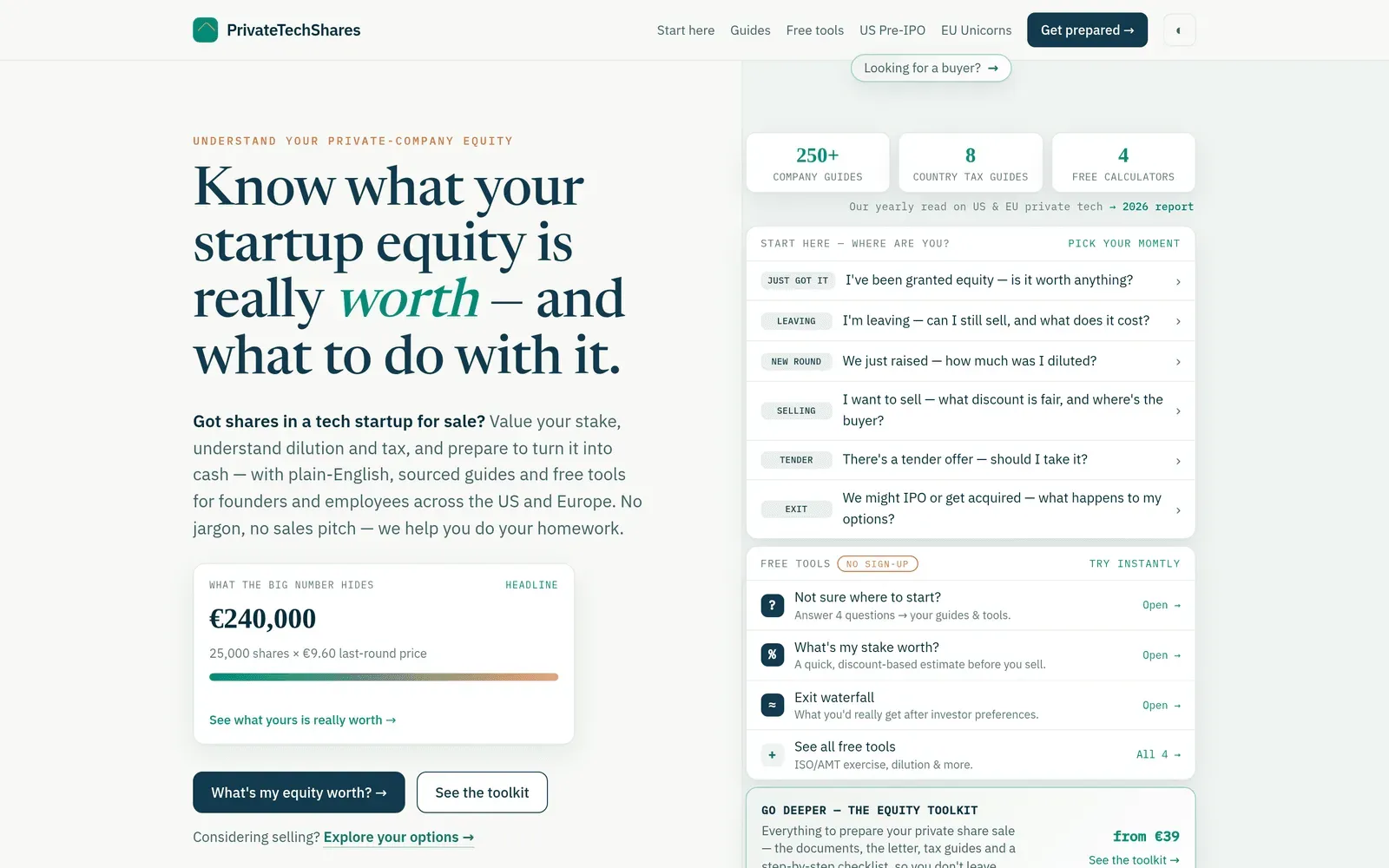
PrivateTechShares is an independent information and preparation resource for individuals holding equity in private technology companies. Its audience is made up of founders, co-founders, current employees with vested options, former employees facing an exercise decision, and early angel shareholders. The platform operates at privatetechshares.com and publishes plain-English guides, free calculators, and paid toolkits covering the United States and seven European markets: Germany, the United Kingdom, France, Spain, Italy, the Netherlands, and Poland.
The operation is intentionally narrow. PrivateTechShares describes itself as an education and tools resource rather than a broker, fund, or marketplace. It does not hold shares, introduce buyers, or take a percentage of any transaction. Instead, it occupies the preparation layer of the private secondary market, helping individual holders understand what they own, what a stake might realistically fetch at a discount to the last funding round, how much exercising options costs, how dilution alters outcomes, and how a sale is taxed locally.
Supporting material includes more than 250 individual company pages covering names such as OpenAI, Anthropic, SpaceX, Stripe, Databricks, Revolut, Monzo, and Helsing, eight country tax guides, four free calculators, and an annual research report on US and European private technology. The team is small and reachable through a single contact address, with every enquiry answered personally according to the site.
Services & Expertise
PrivateTechShares organises its offering into free diagnostic tools, paid preparation products, and a substantial library of guides. Each item addresses a discrete stage between receiving a grant and converting it into cash.
Free equity valuation estimator. The estimator prices a holding off the most recent round price and then adjusts for holding type, liquidity, and buyer demand. Users enter a share count, the last-round price per share, whether the stake consists of common shares, unexercised options, or preferred stock, and select a company stage ranging from early and illiquid to later-stage with strong demand. The output is a range rather than a single figure, presented as the realistic private sale price, alongside the last-round headline value and an estimated net amount. A short note flags that virtual or phantom units, such as German VSOP arrangements, are usually cash-settled and cannot be sold on a secondary market.
Option exercise calculators. A free tool converts vested options and strike price into the total cash cost of exercising, then shows the last-round value of the resulting shares and the paper gain before tax. A country selector adds rough tax orientation for Poland, Germany, France, and the United Kingdom. A separate American version layers in Alternative Minimum Tax and ordinary income treatment, which the site identifies as the principal trap for holders of incentive stock options.
Equity Starter Kit. Provided free and without an email requirement, the starter kit contains the private sale journey from beginning to end, an explanation of what genuinely determines the value of a holding, a plain-English equity glossary, and a first request letter that a holder can send to a company to obtain paperwork. The letter is positioned as the quickest route to a cap table extract, grant documents, and shareholder agreement terms.
Equity Toolkit, US edition. Priced at $39, the American toolkit delivers an eight-phase process map with explicit stopping points where a lawyer, tax adviser, or notary must take over. It includes a live net proceeds calculator, an offer comparison sheet, a target price model, a Deal Room control panel, a readiness audit, company-side draft documents, and eleven ready-to-send messages. Subject material covers incentive and non-qualified stock options, the Alternative Minimum Tax, and Qualified Small Business Stock treatment.
Equity Toolkit, Europe edition. Priced at €39, the European edition mirrors the same eight-phase structure and adds transfer and tax playbooks for Germany, the United Kingdom, France, Spain, Italy, the Netherlands, and Poland. Its calculator models discount, exercise cost, fees, tax assumptions, and competing offers.
Equity Position Report. The most personalised product, priced at $129 with an option to add expert human review for $249, takes a holder's own grant details and returns a sourced report. The document contains a one-page position summary, valuation scenarios before and after tax, exercise cost including AMT exposure, dilution projections, an exit waterfall accounting for investor preferences, country tax treatment, a conversation pack of questions to put to a company, buyer, lawyer, or adviser, and a sequenced action plan. The report follows a published Equity Position Methodology, version 1.2026.
Company pages and country tax guides. More than 250 pages cover individual private companies including OpenAI, Anthropic, SpaceX, Stripe, Databricks, Revolut, Monzo, Helsing, Anduril, Celonis, Mistral AI, N26, Trade Republic, Discord, Perplexity, Glean, and Vinted. Eight country tax guides explain how a gain is treated locally, with sources and 2026 figures indicated. An annual private technology equity report rounds out the library as a market read.
How They Work
Engagement follows a self-directed path with three distinct depths. The shallowest is a free diagnostic: a holder can run the valuation estimator or complete the four-question readiness check titled Can I sell my shares, which asks what the holder owns, whether it has vested, whether a right of first refusal or board approval applies, and the approximate size of the intended sale. Nothing is stored, and the tool returns directional guidance rather than a verdict.
A second entry point is the Equity Navigator, which asks four questions and routes visitors to relevant guides and tools. From there, users move through the free library, where the free tools and calculators sit alongside country explainers and the founder field guide.
Paid products are delivered instantly after Stripe checkout with no account creation, arriving as PDF, Word, and Excel files. The Equity Position Report differs in that a holder supplies grant information and receives a finished PDF. Throughout, the site is explicit that nothing constitutes investment, legal, or tax advice and that every document is a starting-point draft requiring review by a qualified local lawyer. The stated operating model is preparation without execution: the holder clears any right of first refusal, obtains approvals, and negotiates directly, while the platform supplies the numbers, language, and sequencing to do so confidently.
Ideal Client Profile
A diluted European founder. A founder of a Series B software company who has been diluted across three rounds and wants to understand what a €200,000 block might net after liquidation preferences, a secondary discount, and local capital gains tax. The European toolkit and the exit waterfall calculator match this need directly.
A departing US employee with options. An employee leaving a company with several thousand vested incentive stock options and roughly ninety days to exercise. The AMT-aware calculator and the US toolkit address the deadline, the cash cost, and the tax angle.
A holder approaching an exit. An early employee at a company nearing an initial public offering or acquisition who wants to know what happens to unexercised options and how preferences affect the payout. The company-specific pages and the waterfall tool serve this case.
A small stakeholder overlooked by larger platforms. A former employee holding a stake worth under €10,000 in a European unicorn, for whom institutional secondary venues are not structured. The free guides and the readiness check provide orientation before any paid commitment.
An early angel or adviser. A shareholder in a company that never opened a round to individual investors, seeking a defensible valuation range and a structured set of questions to bring to a private buyer. The personalised Equity Position Report covers this scenario.
Pricing & Engagement Models
Pricing is fixed and published. The valuation estimator, the exercise calculators, the four-question readiness check, the country guides, and the Equity Starter Kit are free and require no sign-up. The US toolkit costs $39 as a one-off, the European toolkit costs €39 as a one-off, and a combined bundle is offered at €59 against a list price of €78.
The Equity Position Report is priced at $129 for the automated PDF, with expert human review available at $249. Checkout is handled by Stripe, downloads are instant, no account is required, and a 30-day money-back guarantee applies across paid products. There is no subscription, retainer, or commission model, and the platform states that it takes no percentage of any share transaction. Purchases are document-based rather than service-based, so a buyer receives files rather than scheduled advisory time, with the review upgrade on the report as the sole exception.
Editorial Assessment
PrivateTechShares occupies a genuinely under-served position. Larger secondary platforms concentrate on later-stage, institutional-size transactions, leaving individual holders with modest stakes to work through restrictions and tax questions largely alone. By publishing free calculators, dated and sourced country guides, and step-by-step preparation documents, the platform lowers the cost of doing the groundwork before any conversation with a company, lawyer, or buyer.
The principal limitation is scope. The service educates but does not transact, which means a holder still has to clear a right of first refusal, obtain board approval, and locate a buyer independently. The deeper paid products, particularly the $129 report and its $249 reviewed version, are aimed at holders with meaningful positions, and European tax coverage stops at seven countries. Readers outside those jurisdictions must adapt the generic guidance.
The strongest fit is a founder or employee in the US or one of the covered European markets with a stake large enough to justify preparation and small enough to fall outside institutional attention. Those seeking active brokerage, buyer matching, or regulated investment advice should look to a licensed intermediary instead. For holders who want to enter a negotiation with their numbers already organised, this is a credible and inexpensive starting point. A sensible first step is the free estimator, followed by the full guide before any purchase decision.