Overview
Capture Studio is a Windows desktop application that merges screen recording with a non-linear video editor, published by OpenHub AS, a Norwegian software vendor registered under organisation number 937 550 162 and operating from getcapturestudio.com. The product exists for creators who need a finished instructional or demonstration video rather than a raw screen capture. Recording, editing, narration and export all take place inside one programme, which removes the usual hand-off between a capture utility and a separate editing suite.
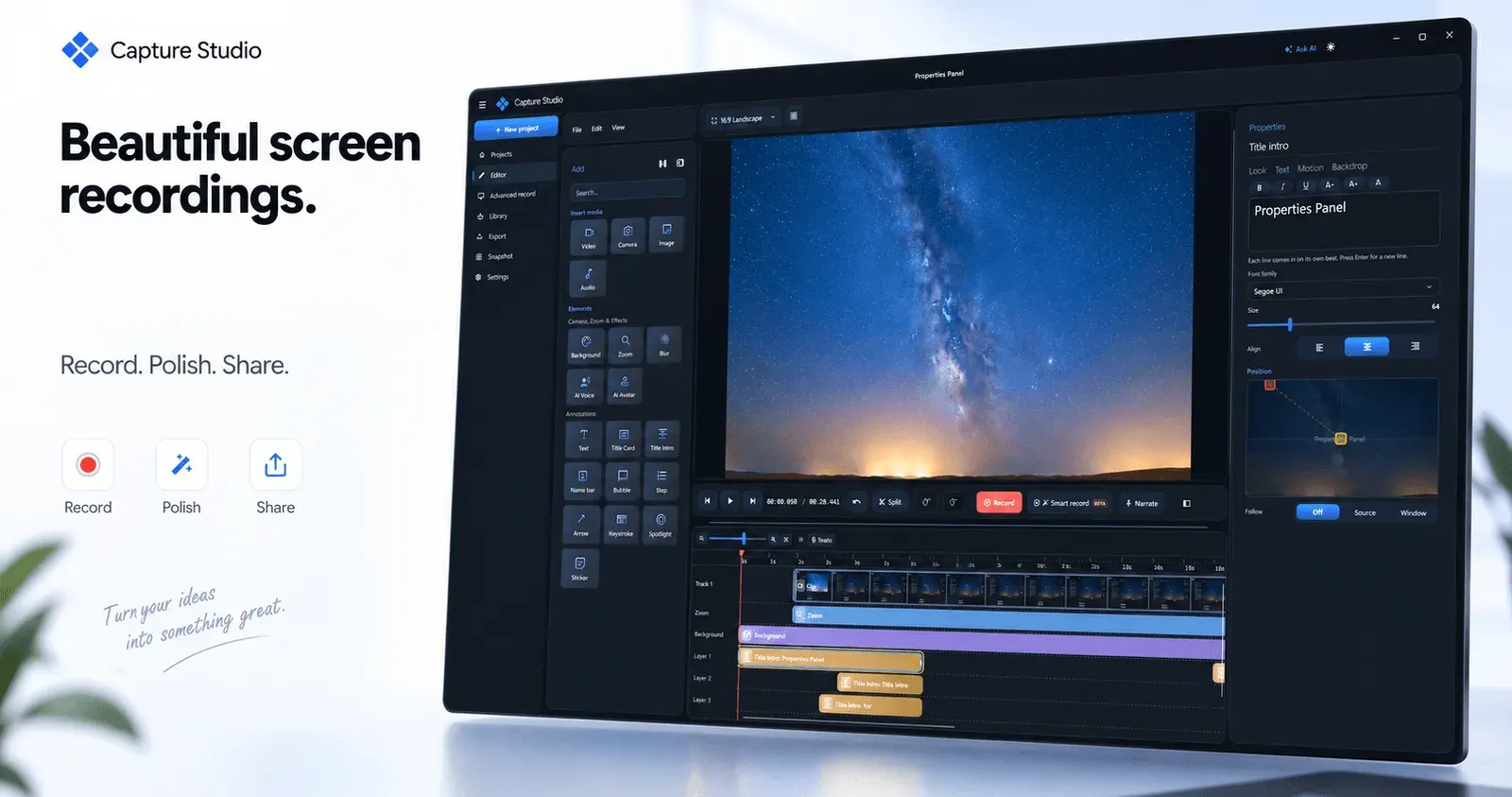
The recorder handles a full display, a single application window, or a region drawn on screen, at frame rates reaching 120 FPS where hardware capability and disk write speed allow. A monitor running at 60 Hz captures at 60 FPS. The editing layer rests on a multi-track timeline with live preview, so the exported result matches what the editor displayed during work.
Two optional neural modules extend the core application. Studio Voice generates narration across 22 languages using 85 neural voices, and Studio Avatar renders a lip-synchronised presenter from a typed script. Both are engineered to run locally on consumer hardware, and OpenHub states that no footage ever leaves the machine. Distribution is currently limited to Windows 10 and Windows 11, with no macOS or Linux build advertised. The buying audience consists mainly of tutorial producers, software trainers, technical writers, product marketers and educators who record screencasts on a regular basis. The licence is sold as a one-time purchase rather than a subscription, which positions the product between free capture tools and heavyweight editing suites such as Camtasia.
Services & Expertise
Capture Studio concentrates on the complete screencast production cycle instead of a single narrow function. Its capabilities break down into the following areas.
Screen, Window and Region Capture. The recorder can take an entire desktop, a single application window, or a hand-drawn region. The outcome is a clean source file ready for the timeline, and the approach suits demonstrators who need to isolate a browser, an integrated development environment, or a dialogue box without cropping the result afterwards.
Timeline Editing with Live Effects. A multi-track editor holds trims, zooms and effects, and every adjustment renders in the preview panel as it is applied. This shortens the review cycle, because the operator sees the final composition while working rather than discovering problems after export.
Smart Zoom and Cursor Polish. Automatic zoom moves follow the pointer and the click points, and the cursor itself can be smoothed with click ripples that guide the viewer's attention. The output resembles the guided walkthroughs common in polished product tours, and manual keyframe zoom remains available when automation frames a scene too broadly.
Titles, Stickers, Arrows and Spotlights. Annotation tools live inside the editor, so emphasis can be added without a round trip to separate image software. The deliverable is a self-explaining recording with labelled steps and highlighted areas of interest.
Studio Voice and Voice Cloning. The premium module generates narration in 22 languages from a library of 85 neural voices, and it can clone a specific speaker from roughly a ten second recording. On the stated minimum specification, a ten second take requires about ten seconds to generate.
Automatic Subtitles and Keystroke Overlay. On-device speech recognition converts narration into styled captions with automatic language detection, while the keystroke overlay prints pressed keys on the screen. Both reduce the manual labour involved in accessibility compliance and shortcut instruction.
AI Avatars, Noise Cancelling and Documentation Export. Studio Avatar delivers the written script as a lip-synced on-camera presenter, noise cancelling strips fan hum and keyboard clatter from audio tracks, and Snapshot tracks the click sequence to generate written steps exportable to Markdown, PDF, HTML or PowerPoint Show.
Supporting features include floating displays with rounded corners and soft shadows, alignment guides that indicate canvas centre and object edges, keyframed privacy blur that can track moving windows, backgrounds and gradients, portable project export, and Android screen mirroring through developer mode.
How They Work
The engagement model is self-service rather than consultative. A buyer selects the Early Bird licence on the pricing section of the site, completes a checkout form processed through Paddle that requests customer type, name, contact details, address and acceptance of the end user licence agreement and terms of service, and receives a licence key once payment clears. Region-aware pricing and a country selector are offered for Norway, Sweden, Denmark, Finland, Germany, the Netherlands, France, Spain, Italy, Poland, the United Kingdom, Ireland, the United States, Canada, Australia and New Zealand.
After activation the workflow follows four stages: capture, arrange, enhance and export. The capture stage settles source geometry and frame rate. Arrangement happens on the timeline, where trimming, zoom, alignment guides and privacy blur are applied. Enhancement covers voice-over, subtitles, avatars and annotation. Export produces the finished file, and a portable project export bundles the project with its media for transfer or archiving.
Add-on modules attach to the same licence key, and OpenHub states that they activate the next time the application checks in. A public roadmap lists upcoming work including application guides, a reliability update for Snapshot mode, additional avatars, and background removal for the camera feed. Support is handled through a separate portal, and a complete feature breakdown is published in the features overview on the product site.
Ideal Client Profile
The product fits individual operators and small teams that record screens frequently and want to skip the round trip through a general purpose editor.
-
Independent course creators producing software training. A solo instructor recording multi-part lessons benefits from keystroke overlays, automatic subtitles and voice cloning, all of which replace tasks normally outsourced to a narrator or a captioning service.
-
Product marketing teams assembling demo videos. A marketing specialist who needs a branded walkthrough can apply backgrounds, floating displays and smart zoom to a raw capture without a separate motion graphics tool.
-
Technical writers generating onboarding documentation. A documentation team can use Snapshot to convert a click sequence into written steps and export them to Markdown, PDF, HTML or PowerPoint Show for an internal knowledge base.
-
Educators and IT trainers recording lessons. A teacher producing repeated modules gains from the local processing model, since student footage and internal systems never leave the workstation.
-
Support and quality assurance teams documenting repeatable procedures. A support group building a ticket resolution library benefits from privacy blur and portable project export when procedures contain sensitive data.
Organisations that need shared seats, centralised licence management, or a cloud collaboration layer will find the single-user orientation limiting.
Pricing & Engagement Models
The catalogue is deliberately narrow. One paid tier, named Early Bird, is listed at 119.00 euro and discounted to 85.00 euro as a launch offer. The price is a one-time charge covering a lifetime licence with one year of updates included. Two premium add-ons, Studio Voice and Studio Avatar, are priced at 21.20 euro each when purchased separately and are included with the Early Bird licence. No subscription plan, per-seat arrangement or free trial is advertised on the page.
Refund terms permit withdrawal within 14 days for a full refund, unless the buyer has begun activating or using the software during that period. Stated system requirements are Windows 10 64-bit as a minimum and Windows 11 64-bit as recommended, four cores at 2.5 GHz or eight cores at 3.5 GHz, 8 GB or 16 GB of memory, DirectX 11 or an NVIDIA RTX 2060, and 6 GB or 10 GB of NVMe storage. Studio Voice asks for an RTX 2070 and 16 GB of memory at minimum, while Studio Avatar asks for an RTX 2060 and 8 GB. Details are consolidated in the roadmap and system requirement tables.
Editorial Assessment
The principal strength of Capture Studio is consolidation. Recording, editing, narration, captioning and documentation export sit in one Windows application, and the on-device processing model gives privacy-conscious teams a credible reason to choose it over cloud-first competitors. The lifetime licence at the launch price is generous relative to subscription rivals, and features such as Snapshot, privacy blur with autotracking, and 120 FPS capture address practical production problems.
Limitations are equally clear. The application runs only on Windows, the neural modules demand a modern NVIDIA GPU, Studio Avatar supports a small set of voices at launch, and the included update window covers just one year. Buyers relying on macOS, integrated graphics, or multi-seat licence administration should look elsewhere. The best fit is the Windows-based solo creator or documentation specialist who records regularly, values local processing, and prefers a single upfront payment to a recurring fee.