
Overview
CertWorthIt is a research and publishing platform built around a single question: is a given certificate worth the money and the time? Rather than repeating vendor claims, the site counts how often real job advertisements name specific credentials and publishes the resulting shares by role, field and country. Counts are drawn from the Adzuna job ad API, and AI tools assist with analysing the data and drafting pages and reports. Every figure published on the site links back to its source.
The scale is notable for a niche publisher. CertWorthIt reports 362,748 job ads counted across ten countries, with 78 certifications carrying job ad data, based on a snapshot dated October 2026. Markets covered include the United States, the United Kingdom, India, Brazil, Mexico, Spain, France, Germany, Italy and Poland, and the interface is published in seven languages. The operation is run by Lumavera OÜ, registered in Tallinn, Estonia under registry code 17438605, with an editor credited as Jere Salmisto. CertWorthIt sits between certification vendors that have an obvious commercial interest in overstating value and generalist careers media that rarely quantify hiring demand. The audience is primarily individual professionals weighing a credential decision, though the same data serves training providers and learning and development teams.
Services & Expertise
Job ad certification counts. The core product is a set of counts showing how often a named certification appears in job advertisements for the roles where it matters most. Each certificate page reports a share of matching ads, for instance PMP appearing in 24 percent of United States project manager ads, and links the figure to its underlying query. The outcome is a defensible frequency number that replaces speculation with a comparable statistic.
Certificate directory and search. A browseable A to Z index covers 78 credentials, from AI-901 and AWS Cloud Practitioner through CISSP, CompTIA A+, ITIL, PMP and SnowPro Core. A search box accepts a certificate name and returns either a match or a fallback path toward the quiz and the full index. The deliverable is fast orientation for anyone who has heard a credential recommended and wants evidence before spending several hundred dollars on exam fees.
Field level guides. Certifications are grouped into seven fields: cloud and DevOps with 20 credentials, cybersecurity with 15, data and analytics with 11, IT support and networking with nine, project management with nine, AI with six, and agile and Scrum with four. Each field page highlights a representative finding, such as OSCP at 73 percent in cybersecurity or SAFe at 22 percent in agile and Scrum. This gives readers a market map rather than one isolated number.
Role based starting points. A roles section reframes the same data from the hiring side, listing which certification United States job ads name most for occupations such as project manager (PMP, 24 percent), network engineer (CCNP, 20 percent), system administrator (ITIL, 7.8 percent) and data engineer (Databricks certification, 173 of 21,791 ads). The outcome is a shortlist tailored to a job title rather than to a vendor catalogue.
Head to head comparisons. Popular comparison pages place two credentials side by side using the same methodology, including CAPM versus PMP, CCNA versus CCNP, CISSP versus OSCP and CSM versus PSM. Because both figures come from the same ad pool and the same period, the contrast is meaningful rather than marketing framing.
Country rankings. Rankings pages order certifications by share of the ads for each credential's main job, with headline leaders such as OSCP at 73 percent in the United States and CCNP at 14 percent in the United Kingdom, plus a combined all countries ranking for cross market comparison.
Personalised reports and quiz. A four question quiz builds a short report from job, experience level and goal, and an email option delivers a country report plus a monthly update. Reports are assembled from the same underlying counts, so personalisation changes the packaging rather than the evidence.
Methodology documentation. A dedicated methodology page sets out how ads are counted, which is unusual transparency for a site of this type and the main reason its numbers can be audited.
How They Work
CertWorthIt is a self service research product, so the engagement is a browsing journey rather than a consulting relationship. A typical visit begins either with a direct search for a named certificate such as PMP, CCNA or AWS, or with the four question quiz covering country, experience level and goal. The quiz is deliberately short, and the site states that two optional questions shape the first step with no email required.
From there the reader lands on a certificate page or a role page. Each shows a share of matching job ads, the size of the ad pool behind it and a link to the source. Charts are accompanied by expandable data tables, so a visitor can inspect the raw numbers instead of trusting a visual. A trust strip near the top of the homepage summarises the inputs: Adzuna API counts, 362,748 ads, ten countries, 78 certifications and the October 2026 snapshot date.
Personalised reports add an optional layer. Country, experience and goal selections generate a report covering the certifications named most for each tracked job in that country and the skills those same ads request. A separate email route sends the report plus monthly updates, with a confirmation link and a one click unsubscribe. An optional newsletter covers month over month movements in certification mentions across the ten countries, plus one new study per issue.
On the analysis side, the process is documented as automated counting of ad text combined with AI assistance for analysis and page writing, with automated checks on figures and sources. Reddit quotes used inside pages link back to their original threads, and certificate facts are taken from vendor documentation. The site is candid that AI is used, and it discloses that some outbound links are affiliate links which never change a verdict.
Ideal Client Profile
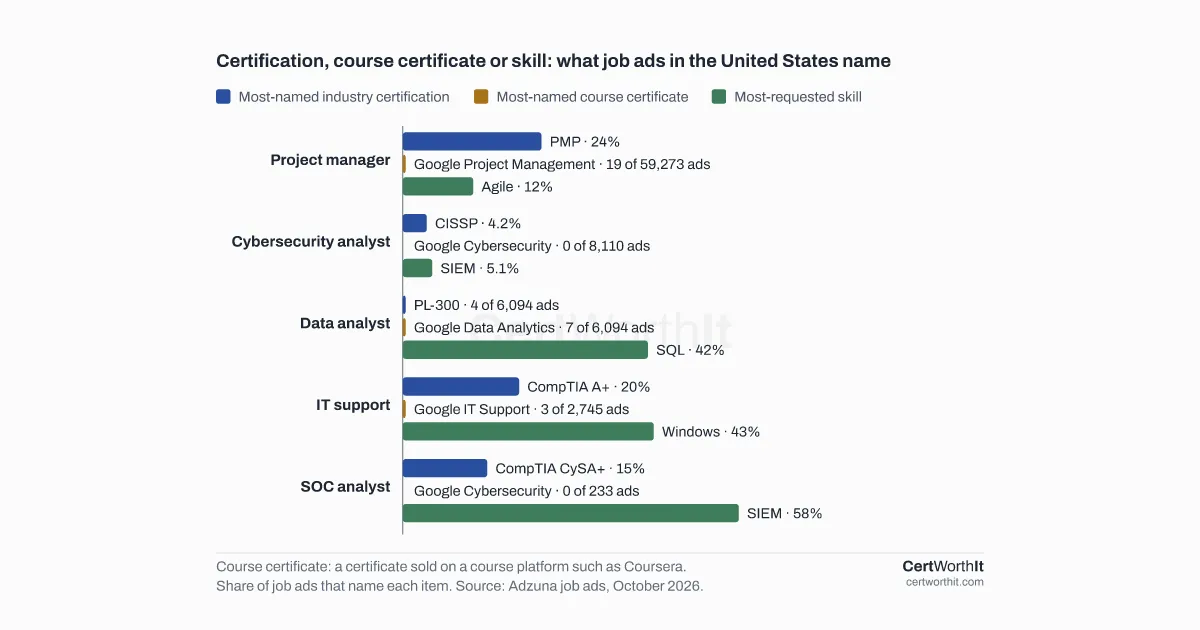
A career switcher choosing a first credential. Someone moving into IT support or data analysis needs to know whether a CompTIA A+ or a Google Career Certificate carries weight with employers. The role pages and certificate directory address this directly, since the data shows CompTIA A+ named in 20 percent of United States IT support ads while the Google IT Support certificate appears in three of 2,745.
An experienced practitioner weighing a senior certification. A network engineer comparing CCNA and CCNP, or a security professional testing CISSP against OSCP, gains most from the comparison pages and country rankings. The 73 percent share recorded for OSCP in the United States is the kind of figure that reframes a decision before exam fees are paid.
A professional planning relocation or remote work. Because counts are published for ten countries, a reader weighing a move to Germany, Poland or Brazil can compare how the same credential registers in a different hiring market, and adjust the shortlist accordingly.
A training provider or bootcamp validating curriculum. Vendors and educators can use the field pages to see which credentials are actually named in ads and which are assumed but rarely requested. The repeated finding that course certificates trail industry certifications and named skills in the same job pool is directly relevant to curriculum design.
A learning and development or recruiting team. Internal teams setting study budgets or writing job specifications can ground requirements in observed ad frequency rather than habit, particularly in cloud, cybersecurity and project management roles.
Pricing & Engagement Models
CertWorthIt does not publish a pricing page, and its core content is free to browse. The certificate directory, field guides, role pages, comparison pages and country rankings are all openly accessible, and the homepage search and quiz require no account. The personalised country report can be generated without an email address, with email used only for delivery and optional monthly updates. Because no paid tier is advertised, the commercial model appears to rest on affiliate links to certification and course providers, disclosed in the footer as never affecting a verdict. For organisations, the practical engagement is a free newsletter subscription or a direct read of the published data. There is no indication of consulting retainers, hourly research or custom packages, so the site is best treated as a free research utility with an email capture attached rather than a paid advisory service.
Editorial Assessment
CertWorthIt occupies a useful and slightly uncomfortable position. Its strength is methodological: counts drawn from a large ad pool, published shares, source links for every figure, an explicit methodology page and a clear statement that AI assists the analysis. The three way comparison of industry certifications against course certificates and plain skills is genuinely informative, and the finding that skills such as SQL and Windows are named far more often than the credentials taught to acquire them is the sort of result that can change purchasing behaviour.
Limitations deserve equal weight. Ad counts measure employer language in job postings rather than hiring outcomes, so a credential named in 20 percent of ads is not proof of a 20 percent advantage in securing a role. Coverage is strongest in large English language markets and thinner where ad volumes are small, which shows in results such as zero Google Cybersecurity mentions across a few hundred SOC analyst ads. Salary effects, employer size and seniority are not modelled.
The best fit is a self directed learner who wants an evidence based shortlist before paying exam fees, and secondarily a curriculum or recruiting team checking assumptions against market language. A reader seeking coaching, exam preparation or employment guarantees should look to training providers instead, and anyone treating the percentages as causal should read the methodology page first. As a free, sourced reference point, the platform earns a clear recommendation.