
Overview
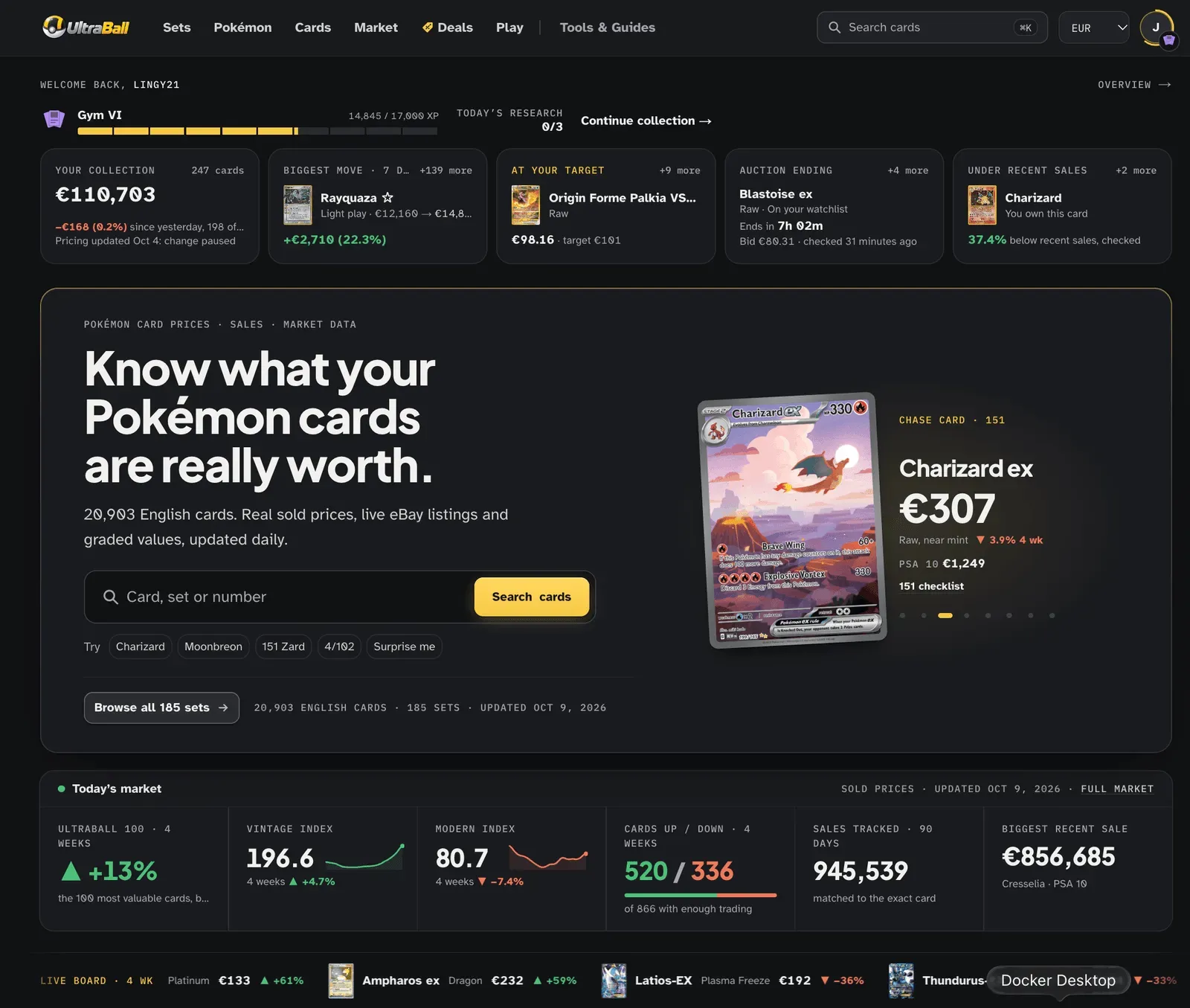
UltraBall is an independent price research and market data platform dedicated to English Pokémon trading cards. Published at ultraball.com, the service catalogues 20,903 cards across 185 sets, stretching from the original 1999 Base Set through to the forthcoming 30th Celebration release. Every card record pairs an ungraded value with its four week movement, a graded condition ladder, a price chart, liquidity markings and a list of recorded sales. The platform presents itself as a reference database rather than a storefront, and its footer states clearly that listed values are estimates and never offers to buy or sell.
Breadth is the project's central claim. UltraBall reports 925,164 sales matched to exact cards inside a rolling 90 day window, alongside a vintage index reading of 196.6 and a modern index reading of 80.7. The largest single transaction on record is a Rayquaza ☆ from the Deoxys set in a CGC 10 Pristine holder at $1,020,000, while the highest ungraded valuation displayed is that same Rayquaza ☆ at $19,999. Figures are refreshed daily, and the home page prints the most recent update timestamp directly beneath its headline.
The primary audience is the collecting public. That includes people checking a childhood binder, modern set builders hunting a specific illustration rare, and hobby investors watching set level movement. UltraBall is not affiliated with Nintendo, Creatures, GAME FREAK or The Pokémon Company, a disclaimer it repeats in plain language rather than burying in small print. Within the trading card data segment, it sits between free community price threads and paid institutional market reports, aiming at hobbyists who want structured evidence rather than anecdote.
Services & Expertise
Card price database. UltraBall catalogues 20,903 English cards, each with an ungraded value, a four week change figure, and links into the individual sales behind that number. Cards are indexed by Pokémon, set, era, rarity and nickname, so queries for Moonbreon, Bubble Mew, Van Gogh Pikachu or the 151 Charizard resolve to one specific printing instead of a generic result. A card page behaves like a compact reference sheet, combining valuation, printing details and transaction history in a single view.
Graded value ladders. Every card record carries separate prices for each grading outcome. PSA, CGC, BGS, SGC and TAG are never blended, and the site states this as policy rather than preference. The distinction matters commercially, because a PSA 10 result and a BGS 9.5 result are not interchangeable, and a blended average would mislead anyone deciding whether a raw copy is worth submitting. Graded prices appear with the sales supporting them.
Market indexes and analytics. The platform publishes composite tracks including the UltraBall 100, Vintage, Modern, PSA 10, Raw and a Charizard specific index. These support broad trend observation rather than single card monitoring. Supporting pages list most traded cards, recent sales, top recent sales, record sales, low population cards, the hardest PSA 10s and the most PSA 10s added, giving a structured view of where activity is concentrating.
Live eBay deal discovery. A deals section aggregates eBay listings alongside auctions ending soon, new listings and price drops. Several tools extend that layer into active buying decisions, including Sniper for auctions with a defined maximum bid, Slab Hunter for raw cards that justify grading, and Grail Radar for high end targets. The outcome is a shortlist of candidates rather than an open ended marketplace feed.
Collector tools. Free utilities include a price checker, a set symbol identifier, an AI card grader, a card centering tool, a grading calculator, a selling calculator and a collection tracker. These reduce manual effort in the two most common collector tasks, namely working out what an unidentified card is and estimating whether a submission would return more than it costs.
Guides and education. Thirty seven guides address valuation, the rarity chart, the differences between 1st Edition, Shadowless and Unlimited printings, counterfeit detection, PSA grading costs and selling channels. They are written for someone who has found a binder in a loft rather than for a professional trading desk, and they link back into the price database at each relevant point.
Play and portfolio features. A daily card challenge, a fantasy portfolio with leaderboards, a pack simulator and Collector Routes add a participation layer. These features are secondary to the pricing engine, but they keep casual visitors returning and encourage collection tracking once an account exists.
How They Work
Engagement begins with search. The home page offers a single field accepting a card name, set name or collector number, supported by quick suggestion buttons for Charizard, Moonbreon, the 151 Zard and the numeric code 4/102. A keyboard shortcut opens the same search from anywhere on the site, and a mobile menu mirrors the full navigation for smaller screens. Visitors who do not know what they are looking for can browse by set, era, Pokémon, rarity or nickname.
Once a card is selected, the visitor sees the ungraded value against recent comparables, then a graded ladder showing what the same card fetches in each holder and grade. Sales evidence sits beside each price, and confidence and liquidity markings indicate how many copies traded and how recently. From there the natural next steps are saving the card to a watchlist, setting an alert, or comparing the raw price against graded outcomes to judge whether submission makes sense.
Account level features extend the workflow. The collection tracker records holdings and measures set completion, Collector Routes frame collecting as a sequence of goals, and UltraBall Wrapped summarises activity over a period. A currency selector covers roughly thirty currencies and converts displayed values, which suits collectors buying across borders. Everything is web based, with no software to install and no import step required before browsing.
Ideal Client Profile
A returning collector with inherited stock. Someone who has opened a box of 1999 era cards and needs to separate genuine value from bulk. The rarity guides, the set symbol identifier and the price checker answer the identification question before any valuation is attempted, and Base Set, Fossil and Jungle pages give immediate context for the most commonly found vintage material.
A modern set builder chasing completion. A collector working through a recent release such as Ascended Heroes or 151 benefits from set level completion tracking, chase card pricing and set value estimates. The site lists set values near $4,652 for Ascended Heroes and $1,773 for 151, which gives a realistic budget target rather than a single card price.
A grading oriented reseller. Someone buying raw cards with the intention of submitting them needs the graded ladder, the grading calculator and the Slab Hunter screening tool. Because PSA, CGC, BGS, SGC and TAG values stay separate, the reseller can model return against a specific grader instead of a blended assumption.
A hobby investor tracking market direction. An individual watching broader hobby sentiment uses the UltraBall 100, Vintage, Modern and PSA 10 indexes rather than individual card pages. Record sales and low population lists supply the outliers that explain index movement, and the 925,164 tracked sales give the trend figures visible backing.
An eBay seller or small shop pricing inventory. A part time dealer listing dozens of cards weekly needs fast price confirmation, recent comparable sales and awareness of auctions ending soon. The deals section, price drops feed and new listings view combine into a workable sourcing and pricing routine.
Pricing & Engagement Models
The home page does not publish subscription tiers, membership levels or per seat pricing, so the commercial structure behind UltraBall is not disclosed to casual visitors. Card pages, set pages, market indexes, guides and the currency selector are all reachable without any visible paywall or sign in prompt, which suggests an advertising or marketplace referral model rather than a gated data subscription. The deals and auction sections route clearly toward eBay listings, and that referral relationship is the most evident commercial mechanism on the site.
Account features such as the watchlist, alerts and collection tracker imply a free registered tier, though no upgrade path, trial period or premium plan is advertised on the home page. Engagement is therefore self directed: visitors evaluate the dataset for free and commit attention rather than money. Anyone needing contractual terms, service levels or negotiated data licensing would need to make direct contact, since none of that is presented publicly.
Editorial Assessment
UltraBall's strongest quality is evidentiary discipline. Prices appear next to the sales behind them, graded markets are kept strictly separate, and thin evidence is labelled rather than concealed. For a hobby in which forum speculation routinely outruns verified transactions, that posture is genuinely useful, and it is reinforced by an explicit disclaimer that the company is not affiliated with The Pokémon Company.
The limitations are structural rather than careless. Coverage is English only, so Japanese exclusives and other language printings fall outside the dataset. Values are estimates compiled from marketplace activity rather than executable quotes, which means they can lag during fast moving periods. Commercial terms are absent from the public site, leaving prospective partners without a clear path beyond contact forms.
A collector, set builder or part time seller seeking transparent price evidence and free tooling will find UltraBall well matched to the task, particularly through its full market overview and the entire guide library. Institutional buyers needing licensed feeds, guaranteed uptime commitments or non English coverage should look to specialist data vendors instead. For the hobbyist audience it addresses, the combination of scale, daily refresh and free access through the free tool collection represents a strong recommendation.