
Overview
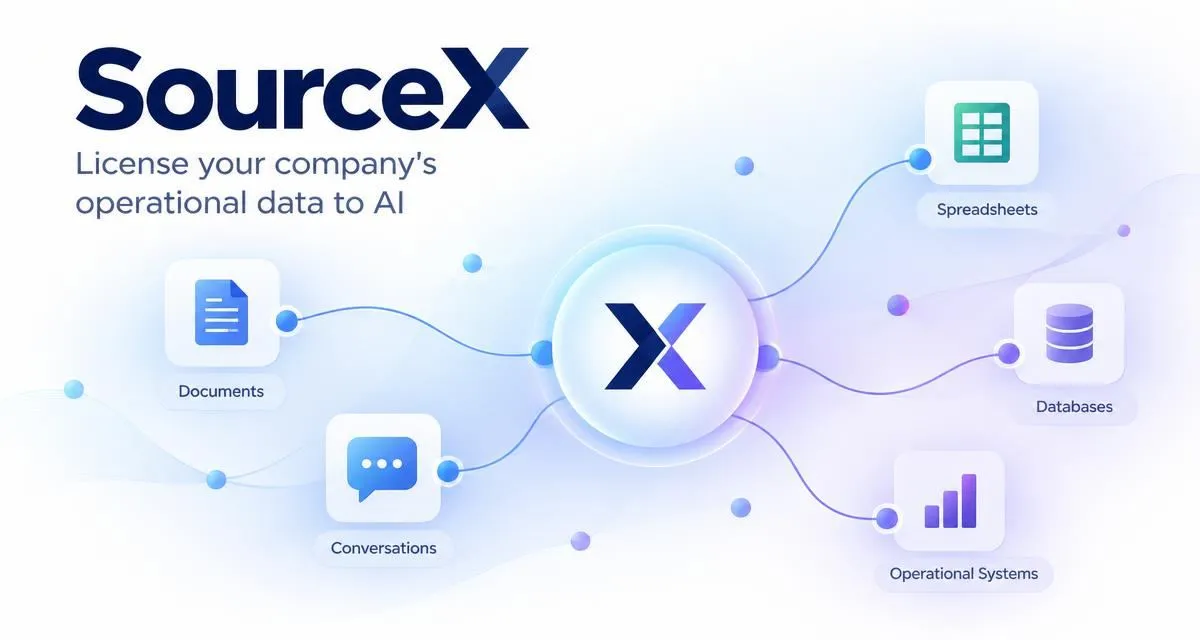
SourceX is a Los Angeles, California based company that describes itself as the enterprise data transaction layer for artificial intelligence. The business sits between two very different constituencies. On one side are operating companies that generate large volumes of everyday work records, including support conversations, sales cycles, engineering histories and internal documents. On the other side are the AI labs that need rights-cleared, real-world material to train and refine their models. SourceX coordinates the entire exchange between them rather than acting as a simple data broker or a passive listing marketplace.
The company's central argument is that public data is effectively exhausted. Most openly available text has already been consumed by today's models, and what remains tends to be duplicated, low quality or legally restricted. Meanwhile, the genuinely instructive material, the decisions, conversations and workflows that show how work actually gets done, lives inside private businesses and never reaches the open web. SourceX frames itself as the infrastructure that unlocks that supply safely.
SourceX does not publicly disclose a founding year or headcount on its homepage, though it confirms a headquarters in Los Angeles, California. Its supplier base is described as companies based in the United States, Canada or the European Union with at least 50 full-time employees at peak headcount, and several years of operating history. On the demand side, the site maps its buyer types to major AI developers including OpenAI, Meta, Google, Anthropic and Amazon, while stating clearly that no affiliation or endorsement exists. For readers who want the mechanics spelled out, how SourceX structures a licensing engagement is documented across the site.
Services & Expertise
Managed data sourcing and fit assessment. SourceX begins by identifying which of a company's records carry licensing potential. The process is framed around the concept of supply: defining the records, the scope and the commercial fit for a given dataset. A short online estimator asks about company size, years in operation, current status, industry and data type, and returns an indicative qualification signal within minutes. No files are uploaded at this stage, which keeps the initial conversation low risk for the prospective supplier.
Rights review and licensing clearance. Before any material leaves a company, SourceX reviews the rights attached to it. This is the second stage in the five step workflow and covers supplier confirmation, ownership questions and any restrictions that would prevent commercial licensing. The output is a documented rights position that a buyer can rely on, which addresses the single largest objection AI developers raise against scraped or otherwise unclear data.
Privacy preparation and deidentification. Preparation is the third stage, and it is dataset specific. Personal details are removed before any record is shared, and the site illustrates this with a simple substitution example in which names and company identifiers are replaced with placeholders. Each preparation step generates its own record, so the privacy process for one dataset can be audited independently of another.
Contracting, approvals and written scope. SourceX manages the agreement itself rather than leaving suppliers to negotiate directly with buyers. The scope of what will be shared, how it may be used and the duration of exclusivity are written into the contract, and the supplier approves those terms before signing. The company is explicit that nothing is released without authorisation.
Delivery and transaction administration. Once terms are agreed, SourceX handles delivery of the prepared dataset to the buyer and administers payment to the supplier. The deal structure described on the site is a one time fee paid after SourceX selects the data in writing, with timing and conditions governed by the signed transaction agreement.
Buyer side matching and data requests. For AI developers, SourceX offers a request channel and a dataset catalogue organised by capability and use case. Buyers can browse categories such as customer support and communication, workflows and engineering, and documents and knowledge, then submit a specific data request. This two sided structure is what distinguishes SourceX from a one directional vendor.
Reference material and research. The company publishes a substantial library of supporting content, including a glossary, comparison pages, templates and checklists, buyer guides and industry specific fit checks. This material is aimed at both sides of the market and functions as an educational layer around the transaction business. A fuller view of available material appears in the data library.
How They Work
SourceX describes a five stage workflow that runs from initial interest to payment. The stages are Supply, Rights, Preparation, Approval and Delivery. Each stage is presented as gated, meaning the transaction cannot advance until the preceding step is complete and documented. The company repeatedly describes this as evidence before release.
A typical engagement begins with the online fit assessment. Five questions cover full-time employee count at peak, years operating, company status, industry and data type. The site notes that companies which are still operating, have been acquired, or have wound down can all qualify. The assessment produces an indicative estimate only and requires no upload or commitment.
If the fit looks reasonable, the conversation moves to scope definition, where the relevant records and systems are identified. SourceX references compatibility with exports from a wide range of platforms, grouped into customer and support tools, sales and CRM systems, engineering and IT platforms, document and knowledge repositories, and finance, legal and operations software. The site explicitly states that these names are shown for reference and do not imply partnership.
From there, the rights and preparation stages run in parallel with commercial scoping. Personal identifiers are stripped, the dataset structure is documented, and a review packet is assembled. That packet is described as containing five elements: where the data came from, the licensing rights position, how it may be used, the privacy process record, and the release authorisation. Only after supplier approval does delivery occur, followed by payment under the signed agreement. Suppliers can decline at any point before signing at no cost, and buyers can submit requests through separate intake. Governance and security documentation is collected in its trust center.
Ideal Client Profile
A software company with a decade of engineering history. Version control records, issue threads and review discussions capture the full loop from problem to resolution. A firm of this shape has years of context, action and outcome data that maps directly to what coding and agentic models need, and it typically has the 50 plus employee headcount that SourceX requires.
A contact centre or BPO operator with years of support transcripts. Escalations, expert responses and resolution paths are precisely the material described under the customer support category. These organisations tend to use platforms such as Zendesk, Intercom or ServiceNow, which the site lists as compatible export sources, making collection straightforward.
A professional services firm holding approved documents and domain knowledge. Law firms, consultancies and accounting practices accumulate structured records and approved documents through real engagements. This falls under the documents and knowledge category and suits organisations that already manage client confidentiality carefully.
A finance or operations department with structured transactional records. Companies running NetSuite, QuickBooks, Xero or similar systems generate consistent, well formed operational data that can be scoped narrowly and prepared predictably.
An AI lab or model developer seeking defensible training material. On the demand side, the ideal buyer is a developer that needs differentiated, rights-cleared records rather than more public web text. A request channel and categorical catalogue support that search. Suppliers who want a broader picture of the process can review the frequently asked questions before deciding whether to engage.
Pricing & Engagement Models
SourceX does not publish tiered pricing or subscription plans. The described commercial model is a one time fee, paid to the supplier after SourceX selects the data in writing. Payment timing and any conditions are set by the signed transaction agreement rather than by a public rate card, so the economics vary by dataset.
The engagement itself is structured as a managed transaction rather than a retainer or an hourly arrangement. There is no cost to withdraw before signing, and submitting a company for review does not commit the supplier to any sale. Exclusivity is usually part of the standard terms, with the restriction applying to the supplier rather than to SourceX, which retains the right to distribute or sublicense the deidentified dataset. Suppliers see the exclusivity term before agreeing.
Editorial Assessment
The strongest element of SourceX's proposition is process discipline. By breaking licensing into five documented stages and attaching an evidence packet to each release, the company addresses the two things that stall real data deals: unclear rights and uncertain privacy handling. Supplier control is genuine in design, since approval is required before delivery and withdrawal before signing carries no cost.
The limitations are equally clear. The 50 employee threshold at peak headcount rules out smaller firms and most startups, which excludes a large share of the companies that might otherwise hold valuable operational records. Exclusivity, while disclosed, is a meaningful restriction for suppliers who might prefer to license the same data more than once. Once data has been selected in writing and the fee paid, the license is permanent, so there is no path to reversal at that stage. Pricing also remains opaque, which makes budgeting difficult without entering the process.
The best fit is an established, mid sized to large organisation in the United States, Canada or the European Union that already manages its data with reasonable discipline and is comfortable with a structured, one time transaction. Companies below the headcount threshold, or those that want to retain the ability to license the same records to multiple buyers, should look at alternative routes to market. For suppliers who meet the criteria and value legal clarity over speed, SourceX presents a credible and unusually well documented option.