Overview
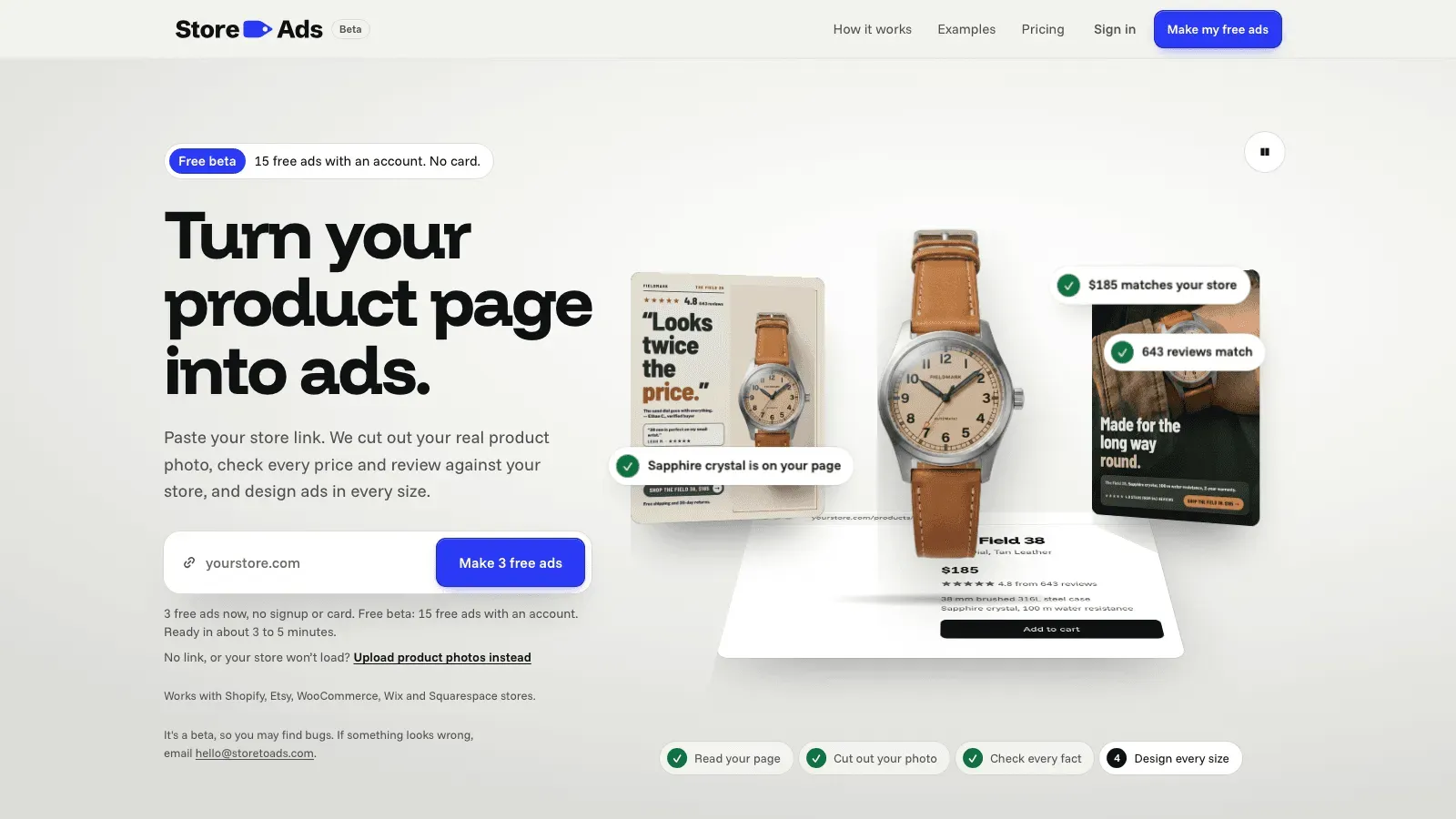
StoreToAds is a browser based advertising production tool for online retailers, marketed as an AI ad generator that builds creative from a store's own product pages rather than from synthesized imagery. The premise is deliberately narrow. A merchant pastes a store or product link, the platform reads the listing, and it returns finished ad designs in several aspect ratios. The product is in open beta, and the company advertises three free ads without registration and fifteen free ads with an account.
The service sits at the intersection of e-commerce operations and paid social production. Its stated workflow reads a product page, isolates the original product photograph, cross checks every price and review figure against the source listing, and then lays out the ad across multiple formats. StoreToAds positions itself as a complement to Meta Advantage+ and Shopify Campaign Autopilot rather than a replacement, which places it in the creative supply layer of the advertising stack: it manufactures assets that existing campaign engines then distribute.
Storefront coverage is broad for a beta product. Shopify, WooCommerce, Wix, Squarespace and PrestaShop stores are read directly from a store link, while Etsy and Amazon sellers paste an individual listing address. Merchants without a supported platform can upload product photographs manually and enter details by hand. Support runs through a single published email address, and the company states plainly that bugs may be encountered during the beta period. Founding date, headcount and headquarters are not disclosed on the homepage, and trademark language confirms no affiliation with Shopify, Etsy, WooCommerce, Wix, Squarespace, Facebook or Instagram.
The competitive framing is worth noting. Rather than promising autonomous campaign management, StoreToAds promises accurate creative assets at volume. That is a smaller claim than most AI advertising tools make, and it is easier to verify.
Services & Expertise
Product page ingestion and catalog discovery. The platform accepts a storefront URL and crawls the listing to extract products, prices, sale prices, review counts and photography. The stated turnaround for a first set of ads is roughly three to five minutes. The output is a selectable product list rather than a single forced result, so a merchant chooses which items become ads.
Product photo isolation. Rather than redrawing a product with generative AI, StoreToAds cuts the original photograph out of its page context and designs the ad around that asset. The company argues this preserves label legibility and product accuracy, which matters for packaging dependent categories such as skincare, supplements and beverages where distorted text is a genuine commercial risk.
Source verification of prices and reviews. Every figure that appears in a finished ad is checked against the merchant's own storefront before the ad is delivered. The homepage describes this in concrete terms: a price is confirmed as matching, a review count is confirmed as matching, and any claim that cannot be traced to the source page, such as an unearned best seller badge, is stripped out. This is the most distinctive feature in the product and the one the company leads with most aggressively.
Multi format ad design. Each paid design is exported in five sizes covering Feed, Story, Square, Pinterest and Google placements, with the layout recomposed for each ratio rather than simply cropped. The free preview tier produces three designs at 4:5 feed size only.
In browser copy editing. Headlines, prices, badges and button text are editable directly in the browser, and the company states that edits are instant and free. This matters for merchants who need to align creative with a specific campaign message without regenerating an entire asset.
On demand and scheduled delivery. Ads can be produced whenever a merchant wants them, or delivered on a recurring schedule. The Lite plan includes a two per week delivery cadence, while higher tiers add larger weekly batches. Scheduled delivery is the mechanism by which the tool becomes a steady creative pipeline rather than an occasional utility.
Paused delivery to Facebook and Instagram. On Growth and above, finished ads can be sent into a Meta advertising account in a paused state, meaning nothing spends until a human approves it. The company is explicit that media budget is paid to Facebook separately.
Category specific idea libraries. A separate section of the site organizes ad ideas by vertical, covering skincare, perfume, jewelry, watches, coffee, candles, clothing and pet products. These pages function as both inspiration and a demonstration of how the system handles different visual categories.
Free diagnostic utilities. The company publishes an ad checker and a product ad readiness assessment as standalone tools, which serve as low friction entry points for merchants who are not yet ready to commit to a plan.
How They Work
The engagement model is self service and fully automated, with a three step sequence that the company reduces to a few minutes. First, the merchant pastes a store or product link and the system locates products, prices, reviews and photography. Second, the merchant ticks the products to advertise and optionally supplies a style direction. Third, the merchant reviews the generated set and keeps what works, with every paid design arriving in all five sizes.
A manual fallback exists for storefronts that block automated reading, which the company acknowledges happens on some platforms including certain Shopify stores. In that case a merchant uploads screenshots of the product page or types the details in, and retains approval authority over the resulting data. The site also offers an alternative path for merchants who prefer conversational interfaces, allowing ad creation inside Claude and ChatGPT rather than through the web application.
The company publishes transparent pricing tiers with no sales call required, and cancellation is handled inside the app. A 30 day money back guarantee applies across plans, with one trial and one refund permitted per store. Approval gates are built into the workflow at two points: the merchant selects which generated ads to keep, and any ads routed to Facebook arrive paused.
Ideal Client Profile
A direct to consumer skincare brand with a large catalog. The photo isolation and label legibility guarantees matter most here, because packaging text is the product's credibility signal and generative redrawing would undermine it. The scheduled delivery cadence suits a brand that needs a steady stream of feed creative without a designer on retainer.
A Shopify merchant scaling paid social for the first time. The three free ads remove the commitment barrier entirely, and the five size exports mean a single approved concept can populate feed, story and Google placements without separate production work.
A handmade seller on Etsy or a marketplace. Because Etsy sellers cannot always expose a full storefront for crawling, the listing link and manual upload paths are the relevant entry points. The price and review verification is particularly useful where review counts are a primary trust signal.
A small agency producing creative for multiple retail clients. Volume based plans starting at $29 per month for nine ads make the economics workable for lightweight retainers, though the tool produces assets rather than strategy, so media planning remains external.
A brand already running Meta Advantage+ or Shopify Campaign Autopilot. StoreToAds explicitly positions as a feeder for those systems, supplying verified creative to campaign engines that handle distribution and optimization. The company makes this comparison directly in its analysis of Meta Advantage+, where it argues the two tools operate at different layers.
Pricing & Engagement Models
Pricing is subscription based with a permanently free entry point. The free beta tier delivers fifteen ads with an account at no cost, requires no card, and is limited to the feed size. Below that, three ads are available without any registration at all.
Lite is $29 per month and includes nine new ads monthly, all five sizes per ad, and a choice between on demand creation and a two per week delivery schedule. Starter is $49 per month for twenty new ads monthly with brand logo and color application on every ad. Growth at $99, Pro at $149 and Scale at $199 add Facebook paused delivery, larger weekly batches and additional capacity. Every plan carries a 30 day money back guarantee, while Growth and above additionally offer a seven day trial that charges nothing at the start. Cancellation is self service.
Editorial Assessment
StoreToAds makes a narrower promise than most AI advertising tools and delivers it more defensibly. The refusal to redraw product photography is the correct architectural decision for physical goods, and the automated verification of prices and review counts addresses a real compliance and trust problem that merchants routinely overlook. Multi size export from a single approved concept is genuine operational leverage.
The limitations are equally clear. The product is in beta, self labeled as bug prone, and supported through a single email address. Free previews are restricted to one aspect ratio, so the multi format claim can only be tested after payment. Merchants whose storefronts resist automated reading face additional setup friction. And the tool produces creative only, with no media buying, audience strategy or performance analytics attached.
Best fit is a small to mid size product brand with an active catalog and existing paid social channels that needs more verified creative at lower cost. Merchants seeking end to end campaign management, or enterprise brands requiring formal SLAs and dedicated account support, should look toward established creative platforms with managed service tiers.