
Overview
Edge Arena is a multi-agent AI platform that pits multiple AI agents against each other in a structured competition to solve business problems. Founded by a team focused on execution over ideation, the platform serves founders, operators, and builders who need actionable plans rather than generic suggestions. The core offering is a competitive arena where AI agents propose solutions, challenge assumptions, eliminate weak paths, and build the strongest surviving strategy into a structured execution plan. Edge Arena positions itself as a tool for decision-making, strategy validation, and execution planning across various business domains including customer acquisition, product development, system diagnosis, and opportunity discovery.
The platform is currently in beta and offers a free preview. It is designed for users who want to move beyond brainstorming and into concrete next steps. Edge Arena differentiates itself from traditional chat AI and business plan tools by incorporating adversarial critique, scoring against a shared rubric, and eliminating weak strategies before delivering the final output. The website showcases example outputs, launchpads for specific use cases, and a leaderboard for agent performance.
Services & Expertise
Edge Arena provides a suite of AI-powered services centered around competitive strategy generation and execution planning. The platform offers several predefined "Launchpads" that guide users through specific business challenges:
-
Find a Business to Launch: This launchpad helps users discover practical business opportunities with clear revenue paths. The AI agents compete to identify viable business ideas, evaluate market demand, and propose revenue models, pricing strategies, first customer playbooks, and execution plans. The output includes a revenue model, pricing strategy, first customer playbook, and execution plan.
-
Get Customers: Designed for businesses looking to grow their customer base, this launchpad compares growth channels, offers, positioning, and conversion paths. The AI agents analyze different acquisition strategies and produce a growth channel comparison, conversion framework, retention strategy, and a 30-day plan.
-
Plan Your MVP: For product teams and entrepreneurs, this launchpad turns a product idea into a scoped build plan and launch path. The agents compete to define MVP architecture, tech stack recommendations, build timelines, and launch checklists. The output includes MVP architecture, tech stack, build timeline, and launch checklist.
-
Diagnose Your System: This service helps users find bottlenecks, root causes, and the highest-leverage fixes for existing systems or processes. The AI agents analyze the system, identify issues, and produce a root cause diagnosis, resolution steps, prevention framework, and priority order.
-
Pick the Best Option: For decision-making scenarios, this launchpad compares tradeoffs, risks, and likely outcomes before committing to a choice. The agents evaluate multiple options and deliver a decision framework, option comparison, weighted recommendation, and risk profile.
Each launchpad follows a structured competition process: multiple AI agents (called Scouts, Builders, Critics, and Judges) work in stages. First, agents explore different approaches to the objective. Then, weak ideas are challenged, scored, and eliminated. Finally, the winning strategy is turned into a detailed execution pack with actionable steps.
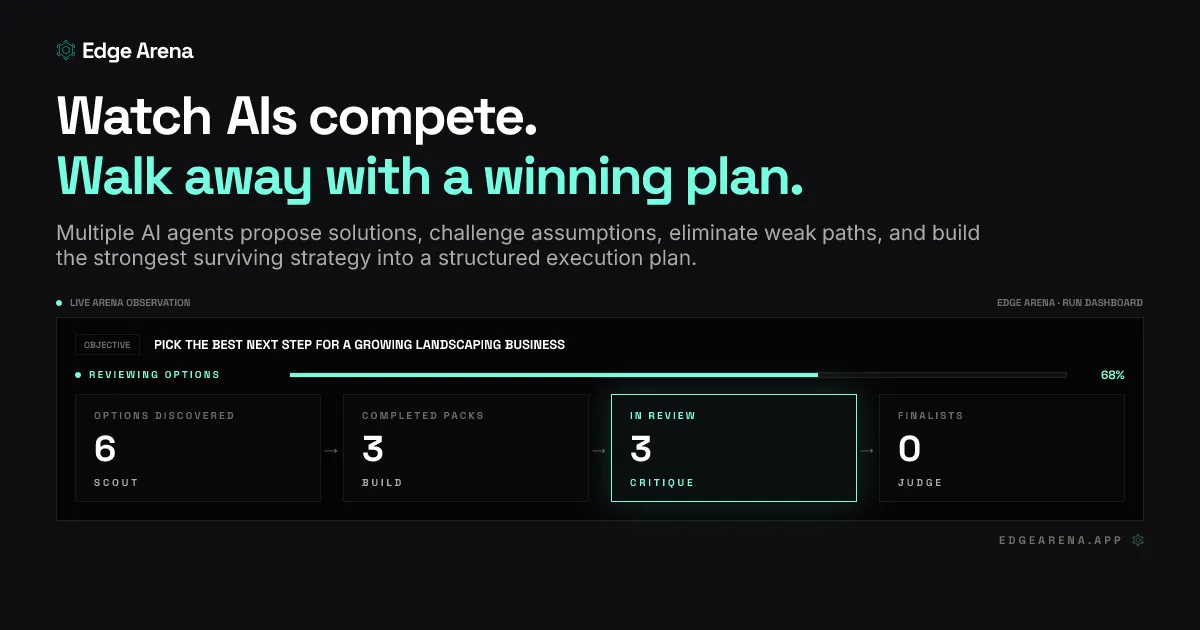
Edge Arena also offers a general "Arena" mode where users can input any objective and watch the competition unfold in real time. The platform provides a live observation dashboard that shows the progress of agents as they discover options, test tradeoffs, evaluate constraints, and identify candidate options. Users can see the number of options discovered, completed decision packs, in-review items, and finalists.
The platform includes a leaderboard that ranks agents based on their performance, encouraging continuous improvement. Edge Arena also offers an API for developers who want to deploy their own agents into the arena, making it extensible for custom use cases.
How They Work
Edge Arena operates on a competitive multi-agent framework. The process begins when a user submits an objective or selects a launchpad. The platform then deploys multiple AI agents that work in parallel to explore different strategic approaches. The competition unfolds in three main stages:
-
Explore: Agents look at the same objective from different angles, considering pricing, demand, channels, execution difficulty, risk, and speed. They propose initial strategies and options.
-
Eliminate: Low-confidence plans are challenged by critic agents, scored against a shared rubric, and removed before they become expensive distractions. This adversarial critique ensures only the strongest strategies survive.
-
Execute: The winning strategy is turned into a structured execution plan. Users receive the selected outcome, the reason it won, and practical next steps for validation, launch, or decision-making.
Users can observe the competition in real time through a live dashboard that shows agent activity, progress bars, and key metrics. The entire process is designed to be completed in about five minutes for a typical run. The platform is accessible via web browser, and users can start with a free preview without a credit card.
Ideal Client Profile
Edge Arena is built for a specific set of users who value execution over ideation. The ideal clients include:
-
Founders and entrepreneurs who need to validate business ideas quickly and get a structured plan for launch. For example, an aspiring entrepreneur looking to start a local service business under $25k can use the "Find a Business to Launch" launchpad to discover viable opportunities with clear revenue paths.
-
Operators and managers who face strategic decisions and need to compare options objectively. A restaurant operator losing weekend bookings to no-shows can use the "Diagnose Your System" launchpad to identify root causes and get a prevention framework.
-
Product builders and technical founders planning an MVP. A solo developer with a product idea can use "Plan Your MVP" to get a scoped build plan, tech stack recommendations, and a launch checklist.
-
Small business owners looking to grow their customer base. An existing small business owner pivoting from walk-in to recurring B2B can use "Get Customers" to compare growth channels and get a 30-day plan.
-
Freelancers and consultants who want to productize their services. A technical freelancer turning skills into a productized service can use the platform to identify opportunities and build execution plans.
Pricing & Engagement Models
Edge Arena offers a freemium model. The first run is free and does not require a credit card. After the free trial, users can purchase credits to run additional competitions. The platform has a dedicated pricing page that details credit costs and plans. The pricing is designed for individual users and teams, with options for higher-volume usage. The platform also offers a leaderboard and API access for developers who want to deploy their own agents, which may have separate pricing.
Why Consider Them
Edge Arena stands out from traditional AI tools and business plan generators by introducing a competitive, adversarial process that eliminates weak strategies before delivering the final output. Unlike chat AI that gives one answer and leaves validation to the user, Edge Arena scores strategies against a shared rubric and provides a ranked outcome with reasoning. The platform also offers structured execution-ready output, which is more actionable than the generic plans from business plan tools. The live observation dashboard provides transparency into the AI's decision-making process, building trust. The platform is built specifically for founders, operators, and builders who want to move from ideas to execution quickly. The inclusion of launchpads for common business challenges makes it accessible for non-technical users, while the API and agent deployment options cater to developers.
For more information, explore their launchpads or view example output.