Overview
Hot Remote Jobs is a free, daily-curated remote job board that aggregates distributed and work-from-home roles across engineering, product, design, marketing, data, customer service, and several adjacent disciplines. The site is organized around a deliberately narrow promise: job seekers can browse more than 60,000 remote listings without registering an account, paying a subscription, or clearing a membership paywall, then apply directly on the hiring company's own careers page. Hot Remote Jobs functions as a discovery layer rather than a staffing intermediary, so it does not sit between the candidate and the employer in the application chain.
The platform targets a global audience. Its job index spans roles tagged for the United States, Europe, Ukraine, and fully worldwide positions, and its filters allow candidates to narrow by country or region, timezone, seniority level, job type, and industry. Listings are refreshed daily and are tagged as curated, which positions the board closer to an editorial digest than to a raw scraped aggregator. Because the service is free at the point of use and does not require a login, it competes primarily on search ergonomics, listing hygiene, and the breadth of its index rather than on premium candidate features.
Services & Expertise
Hot Remote Jobs operates a focused product surface built almost entirely around job discovery and filtering. Its core capabilities include the following.
-
Daily Curated Remote Listings: The board maintains an index of more than 60,000 remote positions that is refreshed on a daily cadence. Each entry carries structured metadata including company name, employer logo or monogram, location scope, employment type, industry tags, and a publication date, which gives candidates enough context to triage listings before opening a detail page.
-
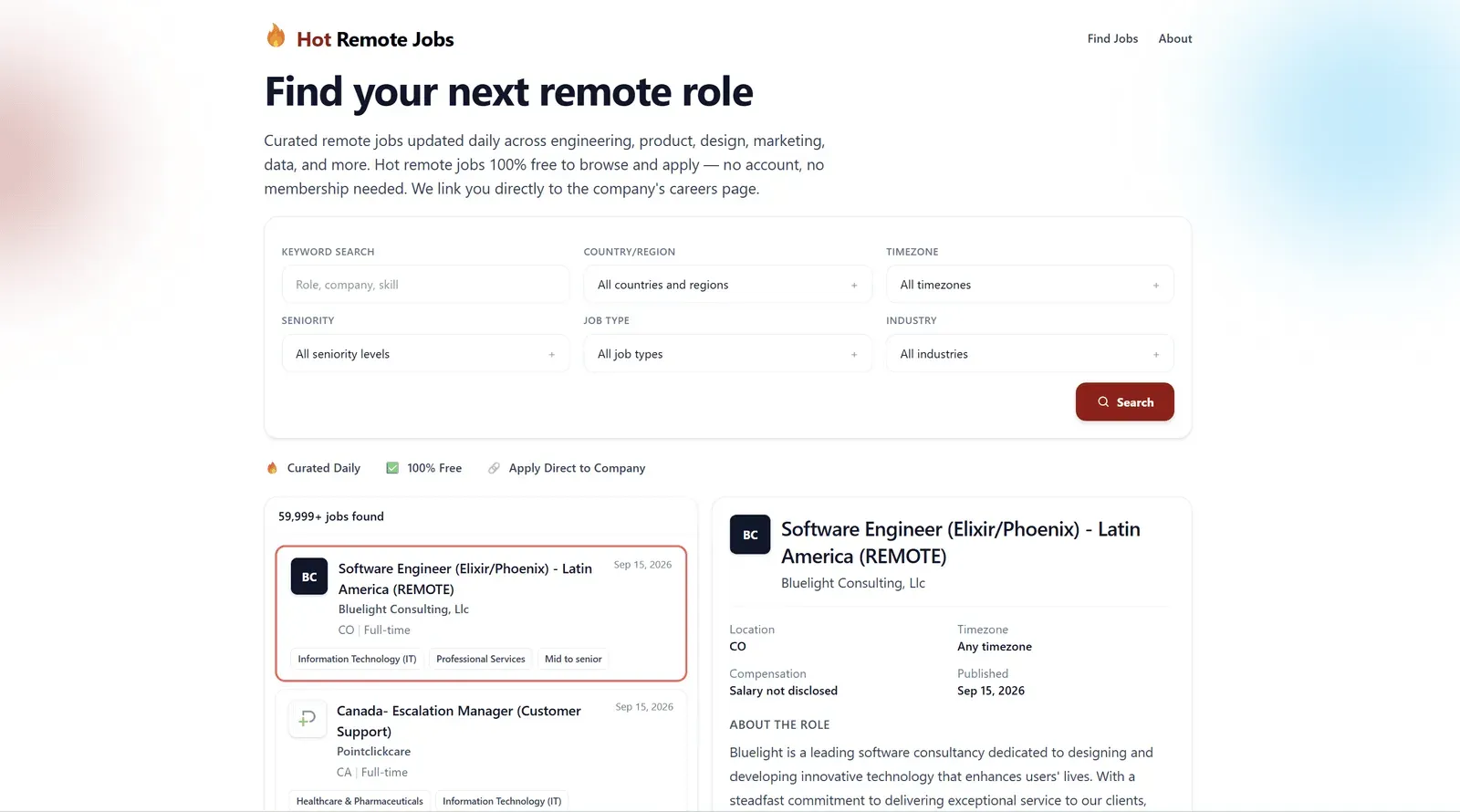
Multi-Dimensional Smart Filters: A filter panel exposes six independent dimensions. Candidates can combine a keyword field for role, company, or skill with selectors for country or region, timezone, seniority, job type, and industry. Timezone filtering is the differentiating dimension here, because distributed candidates frequently need roles whose overlap requirements match their own working hours rather than their passport country.
-
Keyword and Role Search: A single keyword input accepts free-text queries such as a job title, a specific employer, or a technical skill, and returns matching listings from the indexed pool. This is the fastest path for candidates who already know what they want and simply need to confirm the role exists in the remote market.
-
Role-Specific Landing Pages: The site maintains dedicated category pages for high-volume job families, including software engineer, product manager, product designer, DevOps and cloud engineer, AI prompt engineer, and paid media and growth marketing roles. Each page functions as a curated hub that a candidate can bookmark or share, and each is optimized to surface relevant listings without requiring a fresh filter configuration.
-
Location-Based Job Hubs: Parallel location pages organize the same inventory by geography, with dedicated views for remote jobs in Europe, remote jobs in the United States, and remote jobs worldwide. These hubs allow candidates who are constrained by regional hiring eligibility to start from a pre-filtered pool instead of manually excluding ineligible postings.
-
Structured Job Detail Views: Individual listing pages expand the summary card into a full record. A typical detail view presents location, timezone expectations, disclosed compensation where available, publication date, and an employer-written role summary under a clear heading. Compensation transparency varies by listing, but where an employer has published a salary range, the board surfaces it rather than hiding it behind the application flow.
-
Direct Employer Application Links: Every listing routes candidates either to the company's own application destination or to a full detail page that carries the employer's original posting text. This direct-to-employer model keeps the candidate experience transparent, and it means applications are submitted into the employer's own applicant tracking system rather than into a third-party portal.
-
Resume Forwarding Option: Certain listings include an additional convenience path that allows a candidate's resume to be forwarded automatically to hiring managers on the employer side. This functions as a secondary route alongside the standard direct application, giving candidates a faster option when the primary careers page is cumbersome.
-
Employer and Industry Tagging: Roles carry industry labels such as information technology, professional services, banking and finance, biotechnology, retail, healthcare and pharmaceuticals, consumer goods, and entertainment and media. These tags make it possible to screen opportunities by sector, which is useful for candidates transitioning between industries rather than between job functions.
How They Work
The journey begins on the landing page, where a short positioning statement establishes the value proposition and a job feed loads directly beneath it. There is no registration gate, no email capture step, and no onboarding wizard standing between a first-time visitor and the inventory. A visitor can begin scanning listings within seconds of arrival, which is the single most consequential design decision the platform makes.
From the feed, a candidate typically moves to the Smart Filters panel. The panel is collapsed by default and expands on demand, so the default experience remains a clean list of listings while power users can layer constraints. Applying a combination of region, timezone, seniority, job type, and industry re-runs the query and returns a refined result set with a live count. A visible results counter, which reports figures in the tens of thousands, gives immediate feedback on how restrictive the current filter combination is.
Once a candidate identifies a promising listing, the next step is the detail view. There, structured attributes such as location, timezone, compensation, and publication date sit alongside the employer's own role description and a short company summary. From that page, the candidate either follows the direct link to the employer's careers site or uses the resume forwarding option where it is offered. There is no intermediate screening questionnaire, no recruiter gatekeeping step, and no application fee. For employers, the model is equally direct: listings carry employer branding in the form of a logo or monogram, and interested candidates are delivered to the employer's own hiring pipeline.
Ideal Client Profile
The board serves two distinct audiences, and the value proposition differs for each.
-
A mid-level software engineer in Europe seeking timezone-compatible remote work. The candidate filters by European region and by a specific timezone window, then browses engineering listings. The outcome is a shortlist of roles whose synchronous meeting requirements actually match the candidate's working day, rather than a long list of roles that are technically remote but operationally anchored elsewhere.
-
A product designer in the United States who wants to avoid recruiter intermediaries. The candidate uses the product designer hub page, reviews structured detail views, and applies through the employer's own careers page. The outcome is a direct application with no third-party resume broker in the middle.
-
A career changer moving from a non-technical background into an AI-adjacent role. The candidate searches the prompt engineer and AI trainer categories, where listings span employers hiring domain experts in fields such as biology and linguistics. The outcome is a first paid entry point into artificial intelligence work that does not require a machine learning degree.
-
A growth or paid media specialist targeting startup employers. The candidate browses the growth marketing hub, filters by seniority and industry tags such as consumer goods or entertainment and media, and evaluates listings that disclose compensation. The outcome is a filtered pipeline of growth roles at companies that publish salary bands.
-
An employer with distributed hiring needs. A company posting a remote role reaches candidates who are already actively filtering for remote-only work, which improves applicant intent compared with general-purpose job boards where remote listings are buried among on-site postings. The outcome is a higher proportion of applicants who genuinely want a distributed arrangement.
Pricing & Engagement Models
Hot Remote Jobs is free for job seekers, and this is stated explicitly on the site rather than buried in fine print. There is no sign-up requirement, no paywall, no membership tier, and no premium candidate subscription described anywhere in the visible product surface. The engagement model is therefore straightforward browsing and applying, with the platform monetizing through employer-side channels rather than through candidate fees.
For employers, the model appears to follow a standard job board structure in which listings are published to the index and candidate traffic is routed to the employer's own hiring pipeline. Specific employer pricing, listing durations, and promotional placements are not published on the pages reviewed here, so organizations interested in posting should expect to request terms directly.
Why Consider Them
The clearest differentiator is the combination of scale and zero friction. Tens of thousands of remote listings are available without an account, which is unusual in a market where most large boards require registration to view full postings or apply. For candidates who are fatigued by account creation, email verification loops, and resume uploads before the first listing is even visible, the absence of that friction is a material advantage.
The second differentiator is timezone filtering. Remote work is distributed work, and the practical constraint that breaks most remote arrangements is not country eligibility but overlapping working hours. Surfacing timezone as a first-class filter dimension addresses that constraint directly and reflects an understanding of how distributed hiring actually works.
The third differentiator is the direct-to-employer application path. By routing candidates to company careers pages and by not interposing an intermediary, the platform preserves transparency about where an application lands. The optional resume forwarding feature adds convenience for candidates without replacing the standard route.
Finally, the structured tagging layer, spanning industry, seniority, job type, region, and role family, means the same inventory can be sliced in several useful ways. A candidate can approach the market by function, by geography, or by sector, which suits both focused searches and exploratory browsing. The platform is best understood as a lightweight, transparent discovery tool rather than a full career management suite, and for candidates whose primary need is a fast, free, and well-organized view of the remote job market, that positioning is coherent and defensible.